If you've spent more than five minutes on TikTok or Instagram in the last six months, you've seen it: someone topping a salad with chia seeds, a perfectly arranged bowl of berries and oats, the caption "fibremaxxing," the views racking up. The hashtag is everywhere. The Glucose Goddess crowd has adopted it. Half of Reddit's nutrition forums are arguing about it.
Here's the surprise: the trend is right. Not the aesthetics, not the supplement stacks; the underlying nutrition. The UK averages 18 to 20g of fibre per day, and the recommendation is 30g. Most of us are running well short, and most of us don't know it. Fibremaxxing, stripped of the hashtag, is just normal fibre intake. That's it.
This article cuts through the trend and gives you the real version. What fibre actually does in the body, why 30g matters, how to ramp up without the bloat, where supplements fit (and don't), and which natural foods do the heavy lifting. By the end, hitting 30g should feel less like a hack and more like a default.
| Fibremaxxing 101: At a glance | |
|---|---|
| The target | 30g of fibre per day for adults (SACN, UK). The current UK average is 18 to 20g. |
| Why most miss it | Ultra-processed foods strip fibre by design; convenience defaults are fibre-poor. |
| What fibre does | Feeds the gut microbiome, slows glucose absorption, lowers LDL cholesterol, supports satiety. |
| How to ramp up | Add 5g every 5 to 7 days. Drink more water. Aim for plant diversity, not just volume. |
| Best natural sources | Legumes, whole grains, vegetables, fruit, nuts and seeds; most deliver both soluble and insoluble fibre. |
| Where supplements fit | Narrow clinical use cases (psyllium for cholesterol, IBS-C). Not a substitute for natural. |
| The Frive shortcut | 8 to 12g of fibre per meal. Three meals a day reliably hits 30g without tracking. |
Why 30g (and why most of us miss it)
The UK government recommends 30g of fibre per day for adults. That figure comes from the Scientific Advisory Committee on Nutrition (SACN) 2015 carbohydrates report, and it has remained the official line ever since. It's a target, not a ceiling.
The reality is a long way from that. The National Diet and Nutrition Survey shows the UK average sitting at roughly 18 to 20g for adults. Only around 9% of adults hit the 30g target. The gap isn't small; for most people it's the difference between half and full.
The reason isn't mysterious. The modern UK diet is built around convenience: refined breads, breakfast cereals stripped of bran, pre-packaged meals, fast lunches, snack foods. Almost all of those categories have had fibre engineered out for shelf life, mouthfeel and cost. Add a coffee, a sandwich, a ready meal and a couple of snacks, and you can finish the day on 12 to 15g without realising it.
The compounding effect matters. Short term, a low-fibre day means weaker satiety, faster glucose swings and less microbiome activity. Long term, the trajectory looks worse: higher cardiovascular risk, higher colorectal cancer risk, weaker gut diversity.
Our piece on the worst foods for gut health covers the convenience-food side of this in more detail.
What fibre actually does in the body
Fibre isn't one thing; it's a category. The two functional groups behave very differently in the gut, and most natural deliver both.
Soluble fibre
Soluble fibre dissolves in water and forms a gel as it moves through the gut. That gel slows the rate at which glucose is absorbed (the mechanism behind a lot of the "glucose response" videos you've seen), softens stool, and binds to bile acids in a way that lowers circulating LDL cholesterol.
Best natural sources: Oats, beans, lentils, chickpeas, apples, pears, citrus, psyllium husk, chia seeds, flaxseed.
Insoluble fibre
Insoluble fibre doesn't dissolve. It adds physical bulk, accelerates transit time and is responsible for most of the "regularity" effect people associate with fibre.
Best natural sources: Whole grains, wheat bran, vegetable skins, nuts, seeds, beans (yes, again).
The microbiome layer
Both types feed the gut microbiome. When fibre reaches the colon, certain species ferment it into short-chain fatty acids: acetate, propionate and butyrate. Butyrate is the colon's preferred fuel; it strengthens the gut barrier, dampens inflammation and is associated with lower colorectal cancer risk.
This is the bit the trend has right. A high-fibre, plant-diverse diet builds a more diverse microbiome, and that has knock-on effects across glucose control, immune function, and even mood through the gut-brain axis.
Our guide on how to improve the gut microbiome goes deeper here.
Beyond digestion
Fibre's downstream effects are wider than most people realise. It blunts post-meal glucose peaks, lowers cholesterol, supports satiety (because fibre-rich meals stay in the stomach longer), and reduces long-term risk of type 2 diabetes, cardiovascular disease, and several cancers. The 2019 Lancet meta-analysis, covering 185 prospective studies, found that people in the highest fibre intake brackets had a 15 to 30% lower rate of all-cause mortality than the lowest.
The best natural fibre sources (with numbers)
Knowing fibre matters is one thing. Knowing what hits your plate is another. Here are the heavy hitters, with realistic UK portion sizes attached.
A natural 30g day, no supplements
It's worth seeing what 30g looks like assembled, because in the abstract it sounds harder than it is.
| Meal | Components | Fibre |
|---|---|---|
| Breakfast | Porridge oats, chia seeds, raspberries, pear | 11g |
| Lunch | Lentil and chickpea salad, mixed leaves, avocado | 13g |
| Snack | Almonds, apple | 6g |
| Dinner | Quinoa, black beans, roasted vegetables | 12g |
| Total | 42g |
Diversity matters more than volume
Hitting 30g from three foods (oats, beans, broccoli, on repeat) is better than hitting 18g; but it's not the most powerful version. The American Gut Project found that people eating 30 or more different plant species per week had measurably more diverse gut microbiomes than those eating 10 or fewer, even when total fibre intake was similar. Variety is its own input.
Practical translation: count plant species across the week, not per meal. Herbs and spices count. So do nuts, seeds, grains, legumes and the variety of vegetables on a plate. A jar of mixed seeds, a couple of lentil and bean varieties in the cupboard, and a habit of rotating vegetables will get you to 30+ species without much effort.
| Category | Food | Portion | Fibre |
|---|---|---|---|
| Legumes | Lentils (cooked) | 1 cup (200g) | 15g |
| Legumes | Black beans (cooked) | 1 cup (170g) | 15g |
| Legumes | Chickpeas (cooked) | 1 cup (165g) | 12g |
| Vegetables | Artichoke (medium) | 1 medium | 10g |
| Vegetables | Green peas | 1 cup (160g) | 9g |
| Vegetables | Brussels sprouts | 1 cup (155g) | 4g |
| Fruit | Avocado (medium) | 1 medium | 10g |
| Fruit | Raspberries | 1 cup (125g) | 8g |
| Fruit | Pear (medium, with skin) | 1 medium | 6g |
| Whole grains | Bulgur (cooked) | 1 cup (180g) | 8g |
| Whole grains | Quinoa (cooked) | 1 cup (185g) | 5g |
| Whole grains | Oats (cooked) | 1 cup (230g) | 4g |
| Seeds | Chia seeds | 1 oz (28g) | 10g |
| Seeds | Flaxseed (ground) | 1 oz (28g) | 8g |
| Nuts | Almonds | 1 oz (28g) | 4g |
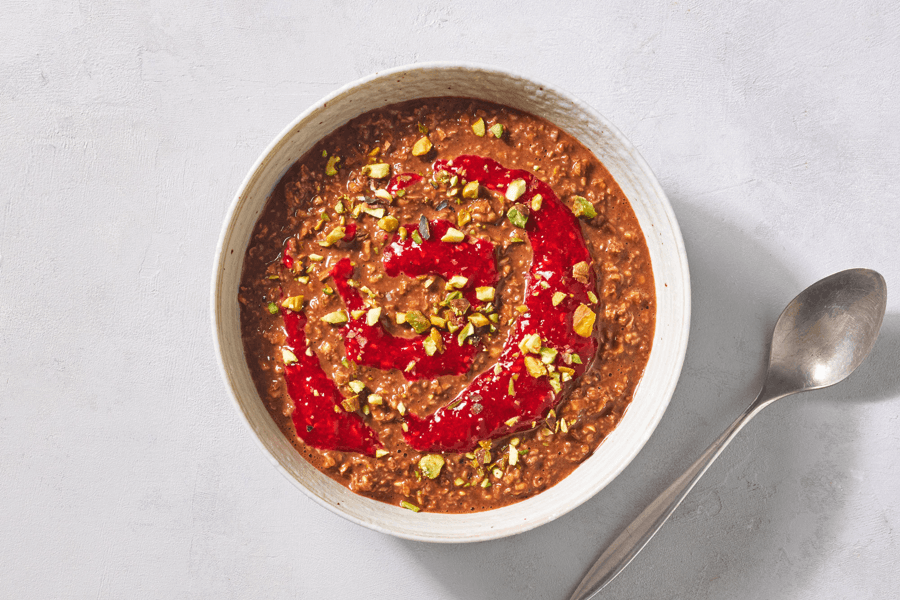
Frive's Chocolate & Raspberry Porridge.
How to ramp up without GI fallout
This is the part the TikToks skip. The single biggest reason ‘fibremaxxing’ attempts fail isn't motivation; it's gas, bloating and discomfort within the first 48 hours. Doubling fibre intake overnight is the most reliable way to feel worse, not better.
The gut microbiome adjusts; it just doesn't adjust instantly. The species that ferment a particular fibre have to grow in number, and the gut needs time to handle the new fermentation load. Push too hard, and the symptoms are predictable.
The 5g rule
The protocol most clinicians use, and the one that holds up in practice, is to add 5g of fibre every 5 to 7 days until you hit your target. That gives the microbiome time to catch up.
If you're starting at the UK average of 18g, the route to 30g looks like this: week 1 at 23g, week 2 at 28g, week 3 at 30g+. Three weeks. No drama.
Hydrate, properly
Fibre needs water to do its job. Soluble fibre forms its gel with water; insoluble fibre softens stool by holding water; without enough fluid intake, both mechanisms misfire and you get the opposite of what you want.
Rule of thumb: an extra 250 to 500ml of water per day across the ramp-up period, on top of your usual intake. If your urine isn't pale straw colour by mid-afternoon, drink more.
Diversity over volume
If your starting point is low diversity (the same three plant foods on rotation), introduce variety before you push volume. A wider range of fibres distributes the fermentation load across more bacterial species, and is much better tolerated than a sudden 15g bean increase from a standing start.
When to slow down
Some bloating in the first week is normal. Persistent bloating, cramping, constipation or diarrhoea past day 10 is a signal to pause and ramp more gradually. People with IBS, IBD or a history of FODMAP sensitivity should ramp slower still, ideally with a dietitian, and lean on lower-FODMAP fibre sources (oats, oranges, kiwi, carrots, courgette) early on.
Where supplements fit (and where they don't)
Fibre supplements have a legitimate role. It's just much narrower than the supplement aisle suggests.
Psyllium husk
Psyllium has the strongest evidence base of any fibre supplement. It's well-studied for LDL cholesterol reduction, glycaemic control, and constipation-predominant IBS. If you have a clinical reason to use it (your GP has flagged your cholesterol, you have IBS-C), it's a sensible tool.
It is not a substitute for natural fibre. Psyllium contains no co-delivered micronutrients, no protein, no polyphenols and none of the food-matrix benefits that come with a lentil or a pear.
Inulin and FOS
Inulin and fructo-oligosaccharides (FOS) are prebiotic fibres that show up in a lot of "gut health" powders and bars. Some people tolerate them well; others get significant bloating and gas at therapeutic doses. They aren't dangerous; they just often deliver more discomfort than upside for casual users.
Why supplements miss the point for most people
A scoop of fibre powder gives you fibre. A bowl of lentil soup gives you fibre, plus 18g of protein, plus folate, iron, magnesium, polyphenols and the satiety effect of actually chewing food. The natural version isn't slightly better; it's a different category.
If your protein, micronutrient and satiety needs are already covered by natural sources and you're just topping up fibre at the margin (say, the last 3 to 5g of a long day), psyllium does the job. If you're using a supplement to paper over a fibre-poor diet, you're solving the wrong problem.
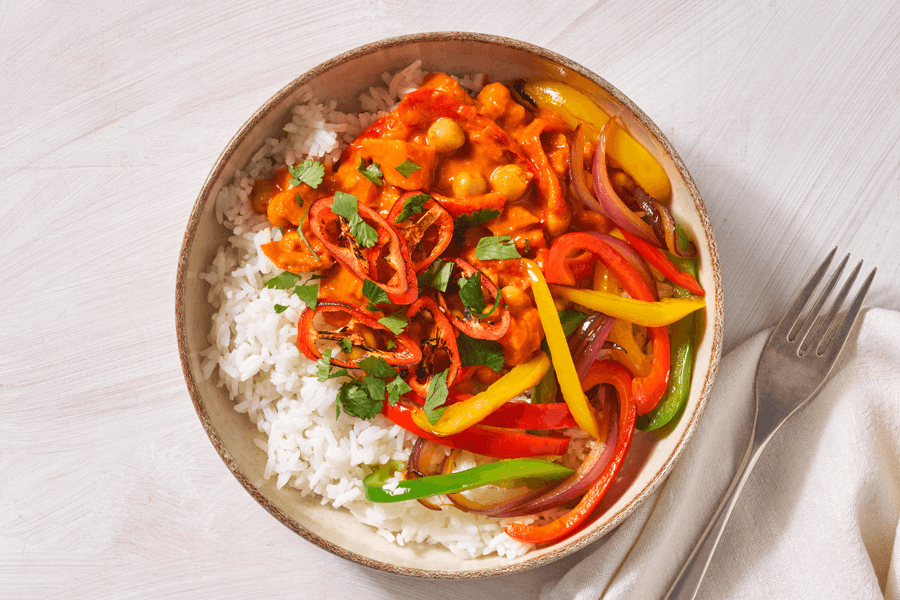
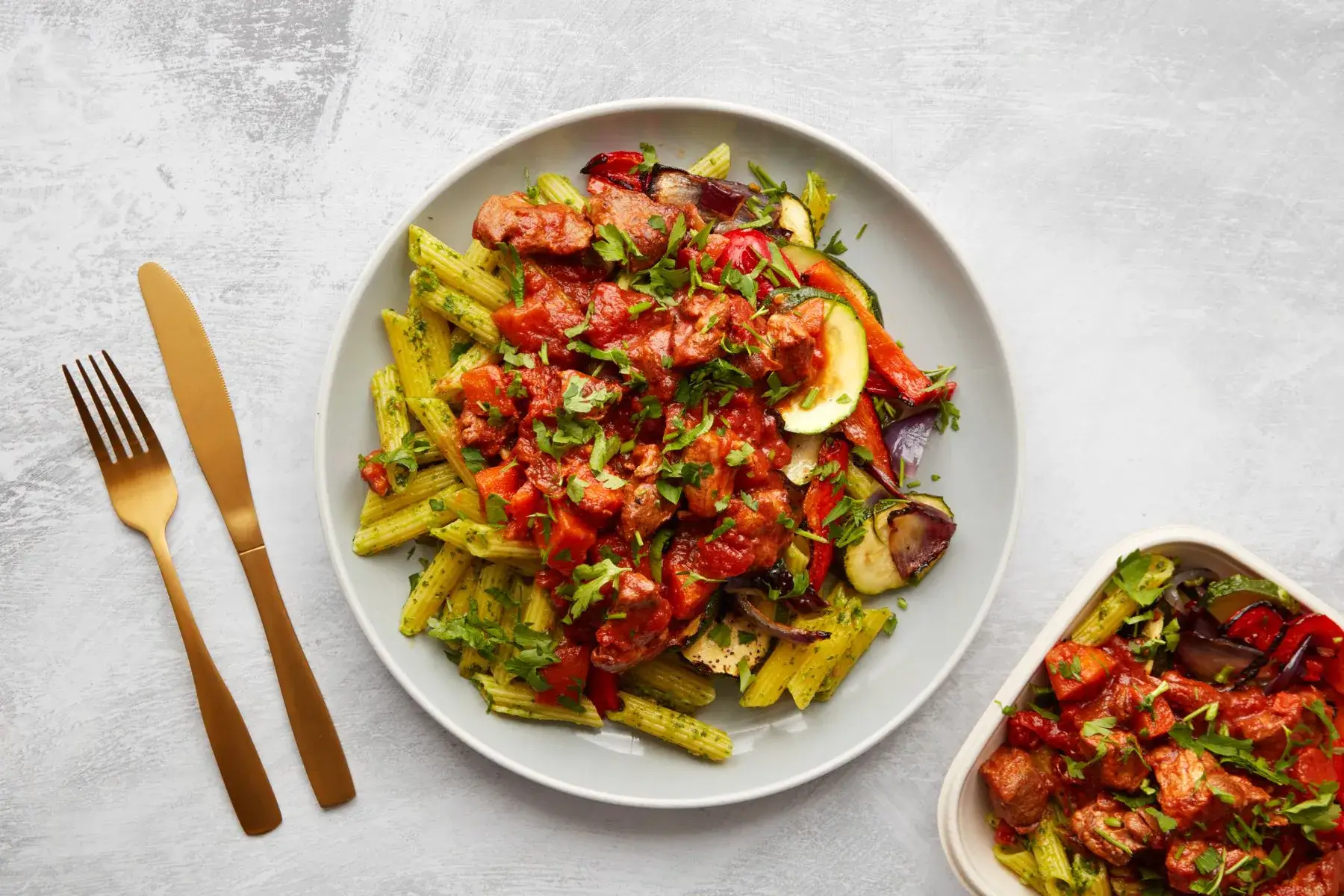
Frive's Sweet Potato & Chickpea Thai Red Curry.
Making 30g a day effortless
Here's the honest part. Hitting 30g a day across a normal UK working week is easy in principle and hard in practice. The principle: a couple of fibre-dense meals, some fruit, a handful of nuts. The practice: shopping, meal prep, cooking and eating fibre-rich food five days a week when you also have a job, commitments and a tolerance for cooking that runs out at about 8pm on a Thursday.
This is why most people's fibre intake doesn't track their fibre knowledge. The information isn't the bottleneck; the operational reality is. Convenience options are fibre-poor by design (it's why eating healthy when you have no time to cook is harder than it sounds), and once you're three nights into a busy week, default behaviour wins.
The system answer
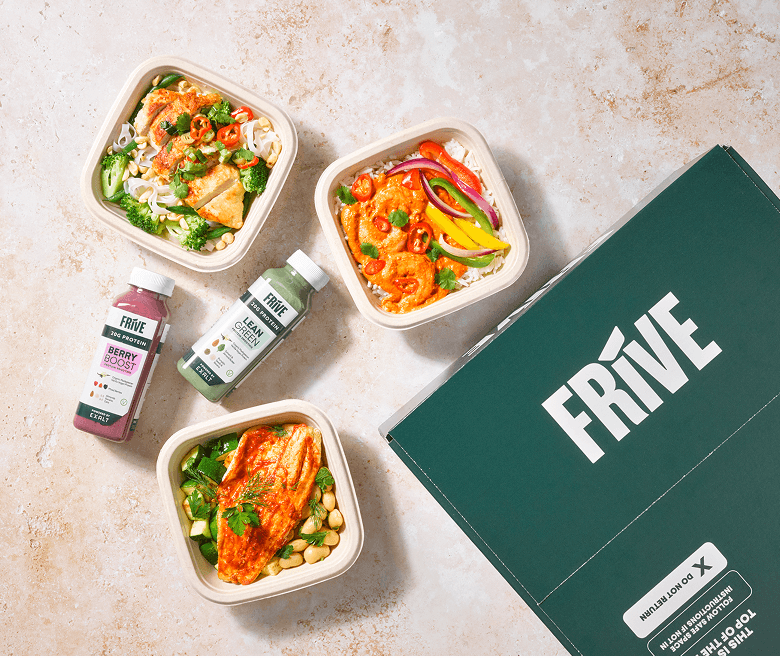
This is what Frive was built to solve. Every meal on the menu is designed around vegetable density, whole grains, legumes and lean protein. Another bonus is that all meals are UPF-free. Three meals a day, five days a week, and you're well on your way to hitting your 30g target.
The point isn't the convenience as a luxury; it's that natural fibre stops depending on whether you have the energy to chop kale at 9pm. The plans make it consistent across the week, so the 30g target stops being a daily decision and becomes a default.
The reframe
Strip the trend back and ‘fibremaxxing’ is just normal nutrition; it's what fibre intake should already look like. The TikTok version overstates the optimisation and understates the basics, but if the upshot is more people noticing the gap between 18g and 30g, that's a net win. The gift of the trend is the attention; the gift of the science was always there.
Hit the target however suits you. Build the meals yourself, lean on a system, run a hybrid. The number to aim at is 30g, the safe ramp is 5g a week, the diversity target is 30+ plant species across seven days. The rest is just dinner.
Frequently Asked Questions
What is fibremaxxing?
Fibremaxxing is the social-media term for deliberately increasing daily fibre intake toward (and sometimes beyond) the 30g UK adult recommendation. The trend is built on real nutrition: most UK adults eat 18 to 20g of fibre per day, well below the 30g target, and closing the gap supports gut health, glucose stability and long-term cardiovascular and metabolic outcomes.
How much fibre should I eat per day in the UK?
The UK Scientific Advisory Committee on Nutrition (SACN) recommends 30g of fibre per day for adults. Children need less: roughly 15g for ages 2 to 5, 20g for 5 to 11, and 25g for 11 to 16. Only around 9% of UK adults currently hit the 30g target.
How do I get to 30g of fibre a day safely?
Increase intake by about 5g every 5 to 7 days until you reach the target. Drink an extra 250 to 500ml of water across the ramp-up period to support the additional fibre. Prioritise variety (aim for 30+ different plant species per week) over volume from a small number of foods, and lean on natural sources rather than supplements.
What are the best high-fibre foods to eat?
The strongest natural fibre sources are legumes (lentils, black beans, chickpeas), whole grains (bulgur, quinoa, oats), vegetables (artichokes, peas, brussels sprouts), fruit (raspberries, pears, avocado) and nuts and seeds (chia, flaxseed, almonds). Most deliver both soluble and insoluble fibre, plus protein, micronutrients and polyphenols.
What is the difference between soluble and insoluble fibre?
Soluble fibre dissolves in water and forms a gel that slows glucose absorption and lowers LDL cholesterol; sources include oats, beans, apples and chia seeds. Insoluble fibre doesn't dissolve and adds bulk that supports regularity; sources include whole grains, vegetable skins and nuts. Most natural foods provide both, so a varied plant-rich diet covers both naturally.
Are fibre supplements like psyllium worth taking?
Psyllium has good evidence for cholesterol reduction and IBS-C management, so it has a legitimate clinical role. For most people, though, supplements are a poor substitute for natural fibre because they don't deliver the protein, micronutrients, polyphenols or satiety that come with food. Supplement only if you have a specific need or are topping up the last few grams of a fibre-rich diet.
Why does fibre cause bloating when you increase intake?
Bloating happens when the gut microbiome ferments more fibre than it's adapted to handle, producing extra gas. The fix is gradual ramp-up (5g per week), more water, and prioritising plant variety over volume so the fermentation load is shared across more bacterial species. Persistent symptoms past 10 days are a signal to slow down or speak to a GP or dietitian.