
Hyrox is eight 1km runs interleaved with eight functional stations: ski erg, sled push, sled pull, burpee broad jumps, rowing, farmer's carries, sandbag lunges and wall balls. Most recreational athletes finish in 60 to 90 minutes of mixed-modal effort. That is not strength training. It is not endurance training. It is both, on top of each other, with no break to choose which energy system you want to use.
Most nutrition advice for Hyrox athletes is borrowed wholesale from either pure-strength bodybuilding content or marathon endurance content. Neither fits. Strength-only macros leave you under-fuelled for the run volume; marathon-style carb loading leaves you heavy and GI-compromised on race morning. The hybrid demand needs a hybrid plan.
This guide is the structured plan: macronutrient targets, training-week fuelling, pre and intra-workout nutrition, the race-week protocol, race-day timing and post-event recovery. If you want the foundational protein logic underneath, start with our guide on how much protein you actually need.
| At a glance: Hyrox nutrition targets | |
|---|---|
| Daily protein | 1.6 to 2.2g per kg of bodyweight |
| Daily carbohydrates | 4 to 7g per kg, scaled to training load |
| Daily fat | 20 to 30% of total calories |
| Pre-workout carbs | 1 to 2g per kg, 1 to 3 hours before |
| Caffeine | 3 to 6mg per kg, 30 to 60 minutes before |
| Race-week carbs | 7 to 10g per kg per day, starting 72 hours out |
| Post-session protein | 25 to 40g within 60 minutes |
| Post-session carbs | 0.8 to 1.2g per kg within 60 minutes |
The macronutrient profile of a Hyrox athlete
Hyrox combines high-volume aerobic running with repeated, near-maximal force production at the stations. That dual demand shapes the macronutrient profile in ways pure-strength or pure-endurance frameworks cannot.
Protein: 1.6 to 2.2g per kg
The sports nutrition consensus for athletes doing resistance training is 1.6 to 2.2g of protein per kilogram of bodyweight a day. Hyrox sits firmly inside that bracket. The sled, ski erg and wall ball stations involve repeated high-force contractions, so muscle protein synthesis needs daily support. Spread intake across roughly four feedings of 30 to 40g, not one large dinner; the leucine threshold to trigger muscle protein synthesis sits around 2.5 to 3g per meal, comfortably hit by 30g of high-quality natural protein.
If you train Hyrox plant-based, the per-meal target needs more deliberate stacking; see our vegetarian protein guide for combinations that hit 30g without relying on isolates.
Carbohydrates: 4 to 7g per kg, scaled to the day
Carbohydrate is the macro most Hyrox athletes get wrong. Copy strength-training defaults of 2 to 3g per kg, and your glycogen stores stay chronically low, so the run sections feel heavy. Copy marathon protocols of 8g+ per kg every day and you carry the weight you then have to drag through the sled.
A workable range is 4 to 7g per kg per day, scaled to the session: heavy days at the top, strength-only days in the middle, true recovery days at the bottom.
Fat: 20 to 30% of calories
Fat is the macro to leave alone once protein and carbs are set. Twenty to thirty per cent of calories from healthy fats supports hormonal recovery, joint health under repeated impact, and satiety. Skew toward olive oil, avocado, nuts, seeds and oily fish.
Total energy: most athletes under-eat
The biggest error in this audience is chronic under-eating. A 75kg Hyrox athlete training five times a week is often burning 2,800 to 3,200 calories a day; many are eating 2,200. The result is fatigue, poor recovery and a slow erosion of performance through the second half of the block. Calculate maintenance honestly, then add to it.
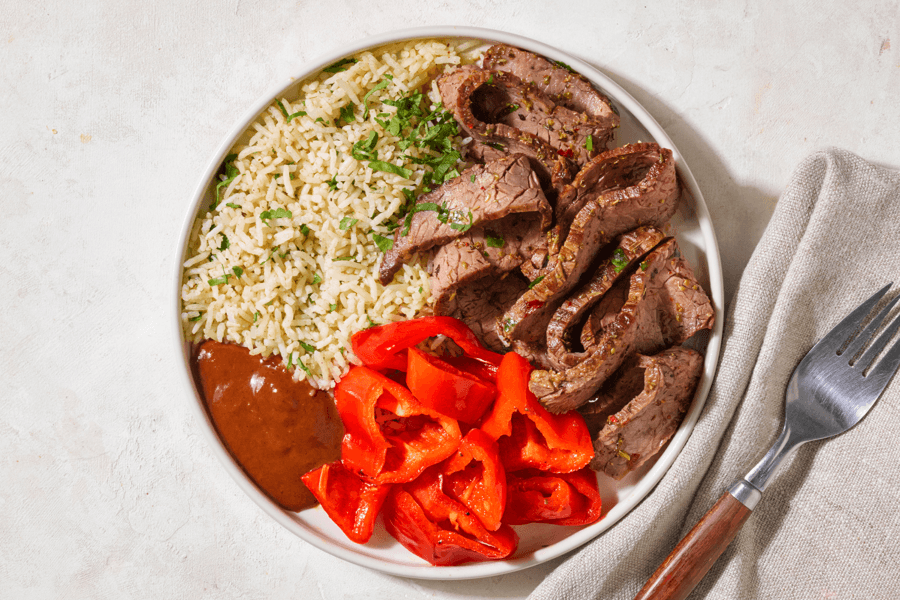
Frive's Smoky Mexican-Style Beef With Lime Rice.
Fuelling across the training week
A Hyrox training week is not uniform. A heavy run day, a strength day, an interval day and a rest day each have different fuel demands. Matching intake to the day is what separates a plan that works in week eight from one that quietly collapses.
Heavy training day: higher carb, peri-workout fuelling
Long rows, sled-heavy compromised runs, race simulations: these days sit at the top of the carb range, 6 to 7g per kg. Eat a carb-and-protein meal 2 to 3 hours before, a smaller carb feeding 30 to 60 minutes before if appetite allows, and replenish within an hour of finishing.
Strength-only day: protein-led, moderate carbs
Push, pull or lower-body sessions are protein-led. Carbs sit in the middle of the range, 4 to 5g per kg. The priority is spreading protein evenly across four feedings.
Recovery or rest day: protein steady, carbs lower, vegetables up
On a true rest day, hold protein at 1.6 to 2.2g per kg and drop carbs to 3 to 4g per kg. Use the saved calories for vegetable density: leafy greens, brassicas, berries. Iron, magnesium, B vitamins and polyphenols all support adaptation between sessions.
A worked example: 75kg athlete, five sessions per week
The table below is a sample weekly structure for a 75kg athlete training a typical Hyrox split. Targets are illustrative; your actual numbers will move with bodyweight, training history and session length.
| Day | Session | Protein | Carbs | Fat |
|---|---|---|---|---|
| Mon | Compromised run + sled | 150g | 450g | 70g |
| Tue | Strength: push | 150g | 300g | 70g |
| Wed | Intervals (run + erg) | 150g | 450g | 70g |
| Thu | Strength: pull / lower | 150g | 300g | 70g |
| Fri | Rest | 150g | 225g | 75g |
| Sat | Race simulation | 150g | 525g | 70g |
| Sun | Recovery walk + mobility | 150g | 225g | 75g |
Pre-workout and intra-workout nutrition
Pre-workout: carb plus protein, timed to the session
Aim for 1 to 2g of carbs per kg, with 20 to 30g of easily digested protein, 1 to 3 hours before. Lower fibre and fat as the window narrows; oats, banana, rice, sweet potato and lean protein all sit well. The closer to the session, the simpler and lower-volume the meal needs to be.
Caffeine: 3 to 6mg per kg, 30 to 60 minutes before
Caffeine has the strongest evidence base of any legal ergogenic aid. Three to six milligrams per kilogram of bodyweight, 30 to 60 minutes before, improves repeated-sprint and sustained-effort performance; the sled push specifically benefits from the neuromuscular alertness it produces. Stay at 3mg per kg if you do not tolerate the higher end.
Intra-workout: only when sessions exceed 90 minutes
Most sessions do not need in-session fuel; stored glycogen covers anything inside 90 minutes. For longer race simulations or back-to-back doubles work, 30 to 60g of fast-absorbing carbohydrate per hour, as a sports drink or gel, is appropriate.
Hydration: simple, electrolyte-aware
Drink 500ml in the two hours before training, then 150 to 250ml every 15 to 20 minutes during, with electrolytes if you sweat heavily or run a session over an hour. Plain water alone in a warm session is the fastest route to a cramp at the wall ball.
The race-week protocol
Hyrox is not a marathon. The race-week protocol is shorter, smaller in carb volume, and more focused on glycogen topping than a full classic carb load. Three days of structured fuelling is enough.
72 hours out: top up glycogen, drop volume
Increase carbs to 7 to 10g per kg per day, spread through your normal meal pattern rather than crammed into a single evening feast. Training volume drops 40 to 50% at the same time. More fuel in, less fuel out: muscle and liver glycogen fill.
48 hours out: maintain carbs, drop fibre slightly
Hold the carb intake. Reduce very high-fibre foods: large salads, raw cruciferous vegetables, bran-based cereals. The aim is to keep stool volume manageable on race morning, not to strip all fibre. Cooked, soft vegetables are fine.
Day before: high-carb, moderate-protein, low-fibre evening meal
The pre-race evening meal is familiar and tested. White rice or pasta with a moderate portion of clean protein (chicken, white fish), a small amount of cooked vegetables, minimal fat. Eat 12 to 14 hours before your start time. Nothing new on the plate.

Frive's Spaghetti & Meatballs.
Hydration: an extra 1 to 1.5 litres a day
Add 1 to 1.5 litres of fluid a day across the three days before race day, with electrolytes in at least one bottle. Pale straw urine is the marker; over-drinking to clear urine strips sodium and leaves you worse off.
Race-day nutrition: nothing new on the day
The pre-race meal: 3 to 4 hours before the start
The main meal sits 3 to 4 hours before your start time. Aim for 1 to 1.5g of carbohydrate per kg of bodyweight, 20 to 30g of easy protein, low fibre, low fat. Porridge with banana and a scoop of whey, or white toast with eggs and honey, are reliable options. The single most important rule on race day is that this exact meal has been tested in training. Race-day breakfast is not the place for novelty.
60 minutes before: a small carb top-up if appetite allows
If you can stomach it, a small fast-carb top-up 45 to 60 minutes before the gun helps top off glycogen and sets up the first 1km run. A banana, a few dates, a small bottle of sports drink, or an energy chew. If your stomach rejects this in training, skip it on race day.
Caffeine: dosed as in training
Take caffeine 30 to 45 minutes before the start, at the same dose you have used in race-pace training sessions. Race day is not the moment to push the caffeine higher; the adrenaline is already on. The combination of an unfamiliar high caffeine dose and pre-race nerves is a classic GI failure pattern.
In-race fuelling: usually unnecessary
If your race is under 90 minutes, glycogen plus the pre-race meal carries you through. For races above 90 minutes (relay anchors, doubles, or slower individual times), a fast-absorbing carb in liquid or gel form between stations is appropriate. Practise it in training first.
Recovery: after training and after race day
Recovery nutrition is where most Hyrox athletes leak performance. The session is over, the discipline is gone, and dinner becomes whatever is fastest. The window matters; the food on the plate matters more.
Within 60 minutes: protein and carbs together
Within an hour of finishing, take in 25 to 40g of protein and 0.8 to 1.2g of carbs per kg. Protein restarts muscle protein synthesis; carbohydrate replenishes glycogen for the next session. A natural meal beats a shake; if you cannot get to one inside the hour, a transition snack first and the main meal soon after works fine.
Within 4 hours: a full natural recovery meal
Inside four hours of the session, the recovery picture should be complete: 30 to 40g of natural protein, complex carbohydrates (sweet potato, brown rice, quinoa), a serving of vegetables, and a healthy fat source. Our guide to the best foods for muscle recovery walks through the specific foods that move adaptation forward.
Sleep takes priority over a perfect meal
Try to finish the recovery meal 2 to 3 hours before sleep. A late, heavy meal disrupts sleep onset and slow-wave sleep, the phase where most physical adaptation happens. If your evening session finishes at 9pm, accept a slightly smaller, more digestible recovery meal rather than pushing bedtime back.
Anti-inflammatory inputs: small but real
Oily fish (salmon, mackerel, sardines), tart cherry, leafy greens, berries and turmeric all reduce post-exercise inflammation in the research. The effect on any single meal is small; stacked across a training week, the impact on perceived recovery and sleep quality is real.
Making this work across a 12-week training block
On paper, a Hyrox nutrition plan is straightforward. Hit protein, scale carbs, recover within an hour, hydrate, sleep. In practice, it asks for shopping, prepping and cooking five or six days a week for twelve weeks. Most plans collapse between weeks four and eight.
The collapse rarely looks dramatic. Training fatigue layers on top of cooking fatigue, layers on top of decision fatigue. The Tuesday night decision becomes a takeaway rather than a 35g protein meal. Three nights and the week is gone; three weeks and the training block has lost its nutritional spine.
This is the gap a meal system fills. Frive is built around the macronutrient profile in this article: 30 to 40g of natural protein per meal, complex carbs as the base, vegetable density for the micronutrient load, and a three-minute fridge-to-plate window so that finishing training at 8.30pm does not mean ordering a pizza by 9.15. Protein from whole cuts of meat and fish, never reformed; carbs from sweet potato, brown rice and quinoa, not refined fillers.
If you want to see how this maps across a training block week by week, our guide on a 7-day meal prep for muscle gain walks through the practical structure. The point is the system, not willpower; nutrition is the half of Hyrox training most athletes quietly lose, and it is the half a system can solve.
The bottom line
Hyrox is a hybrid event that punishes athletes who fuel it like a single-discipline sport. Protein at 1.6 to 2.2g per kg, carbohydrates scaled from 4 to 7g per kg across the week, fat at 20 to 30% of calories, a 72-hour race-week top-up rather than a full carb load, a tested race-day breakfast, and a recovery window inside the first hour. The science is settled; the execution is the work.
Get the macro framework right and the training does the rest. Browse the Frive menu to see how the nutrition profile in this article looks on the plate, delivered fresh and ready in three minutes.
Frequently Asked Questions
How many calories should a Hyrox athlete eat?
Most recreational Hyrox athletes training four to six times a week need between 2,500 and 3,200 calories a day, with the upper end on heavy training and race-simulation days. Calculate maintenance using an activity-adjusted estimate, then increase if performance is dropping; chronic under-eating is the most common mistake in this audience.
How much protein should I eat for Hyrox?
Aim for 1.6 to 2.2g of protein per kilogram of bodyweight per day, spread across three to four meals at 30 to 40g each. The dual demand of running volume and station strength work means protein supports both muscle preservation and recovery; under-eating it costs strength faster than it costs conditioning.
Should I carb load before a Hyrox race?
Yes, but on a smaller scale than a marathon. Increase carbohydrate intake to 7 to 10g per kg of bodyweight per day for the 72 hours before race day, while reducing training volume. A full marathon-style three-day carb load will leave you heavier than you need on the sled.
What should I eat on Hyrox race-day morning?
Eat a familiar, tested meal 3 to 4 hours before your start: 1 to 1.5g of carbohydrate per kg of bodyweight, 20 to 30g of easy protein, low fibre and low fat. Porridge with banana and whey, or white toast with eggs and honey, are reliable choices. Never try a new food on race day.
Do I need gels during a Hyrox race?
Most athletes finishing inside 90 minutes do not need in-race fuelling; stored glycogen plus the pre-race meal carries them through. Gels or fast-carb drinks are useful for races over 90 minutes, doubles or relay anchors. Always practise in training before using on race day.
How much caffeine should I take before a Hyrox race?
Three to six milligrams of caffeine per kilogram of bodyweight, taken 30 to 45 minutes before the start, at the same dose you have used in training. Race day is not the time to push the dose higher; an unfamiliar dose layered on adrenaline is a common cause of GI distress.
What should I eat after Hyrox training to recover?
Within 60 minutes, take in 25 to 40g of protein and 0.8 to 1.2g of carbohydrate per kg of bodyweight. Inside four hours, eat a full natural recovery meal with 30 to 40g of protein, complex carbohydrates, vegetables and a healthy fat. Natural foods outperform shakes for everything except in-race or immediate post-session convenience.