It's 8:15pm on a Tuesday. You've just closed your laptop after a day that didn't have any obvious gaps in it, and now you're standing in a quiet kitchen with one of two choices ahead of you. Spend the next forty-five minutes prepping, cooking and washing up a proper meal, knowing you'll be in bed past 11pm with the stress of the kitchen still in your system. Or order something from a delivery app, eat it in fifteen minutes flat, and feel slightly hungover with yourself by morning.
If that scene sounds familiar, you are absolutely not alone. The British national average dinner time is now 6:12pm; according to OpenTable and Zonal data, just 2% of UK restaurant bookings are after 9pm. That is the country at large. It is also a working week that doesn't really exist for the people reading this article.
The late-finishing professional, the late-meeting parent, the founder, the shift worker; if your day usually ends between 6:30pm and 8:30pm, you live in the window the national average has already left. And that window comes with a biological cost most people don't see until it has been compounding for months.
The good news is that the fix is not what most wellness content tells you it is. "Just eat by 6pm" is fine advice for someone whose calendar lets them; for everyone else, it is a polite way of saying "you're the problem." You're not. The cooking step is the problem. This guide explains why, and gives you the system that actually works on the nights you finish late.
| The post-work dinner problem: At a glance | |
|---|---|
| The 8pm problem | Late-finishing UK professionals are eating in a window the national average (6:12pm dinner) has already left, and the cost lands on their sleep. |
| The biology | A late meal stalls the 0.5 to 1°C core body temperature drop sleep needs, blunts deep sleep, compresses REM, and raises next-day insulin resistance. |
| The cortisol trap | Cooking from scratch at 9pm is an executive-function task that re-elevates cortisol at exactly the point your nervous system should be downshifting. |
| The UPF trap | Postprandial glucose is roughly 17% higher at 8pm than 8am. A late ultra-processed takeaway combines bad timing with the worst possible composition. |
| The compounding cost | Poor sleep means a depleted decision budget tomorrow, which makes the 8pm dinner trap more likely to repeat. The loop is self-reinforcing. |
| The fix | Eat a 30 to 40g protein, low-glycaemic, natural meal that gets to the plate in under five minutes. The cooking step must have happened earlier in the week. |
Is it bad to eat dinner after 8pm?
Eating after 8pm is not categorically harmful for healthy adults. What you eat and how you prepare it matters more than the hour on the clock. A cooked-from-scratch, high-glycaemic or ultra-processed meal at 9pm reliably blunts deep sleep, compresses REM and raises next-day insulin resistance. A small natural meal heavy on protein and low-glycaemic carbs that takes under five minutes to put on a plate is much closer to neutral. The biology cares about composition and speed, not just timing.
Why late-night cooking actually disrupts your sleep
Your body doesn't just shut down at midnight. It runs through a quiet sequence of biological hand-offs in the hours before sleep, and a late meal interrupts almost all of them.
Digestion stalls the cooling process sleep depends on
Sleep onset is governed by core body temperature. To drift off easily, your internal temperature needs to drop by roughly 0.5 to 1°C in the hour or two before bed. Research led by Swiss chronobiologists Kurt Kräuchi and Anna Wirz-Justice has shown the speed of that temperature drop is the single best predictor of how quickly you fall asleep; better even than melatonin onset or how sleepy you feel.
Eating a substantial meal throws a wrench into the cooling process. Blood flow re-routes to your gut, metabolic activity climbs, and your core temperature stays elevated. You're then trying to fall asleep in a body that is still, biologically, running its day-shift. Most people experience this as the "wired-but-knackered" feeling at 11pm: restless legs, a racing mind, the inability to actually switch off despite being exhausted.
Late meals compress deep sleep and fragment REM
The two stages of sleep that do the heavy lifting are slow-wave sleep (physical repair, immune work, brain detox) and REM (emotional and memory consolidation). Both are sensitive to when you last ate.
A 2019 sleep-clinic study published in the Journal of Clinical Sleep Medicine found that participants eating closer to bedtime took longer to fall asleep, experienced more fragmentation through the night, and, in patients with sleep apnoea, had measurably worse breathing scores. The broader meal-timing literature backs this up: late eaters reliably sleep worse and recover less, even when their total calories, macros and sleep duration are matched to early eaters.
Tomorrow is when you pay for it. You wake up with less of the sleep that does the work, which means a depleted decision budget by 6pm, which makes the 8pm dinner trap more likely to repeat. The loop is self-reinforcing.
For the next-day cost in detail, our guide on why you wake up tired after 8 hours of sleep walks through the mechanics.

Try Frive's tantalising Teriyaki Salmon Noodles.
The cortisol-and-cooking trap
Cooking is a cognitive task, not a wind-down activity
Cortisol, the body's primary alertness hormone, follows a strict daily rhythm. It peaks 30 to 45 minutes after you wake, declines through the day, and bottoms out somewhere between 2am and 4am. That decline is what allows your nervous system to hand over to the parasympathetic side and lets sleep begin.
Cooking from scratch fights the curve. Following a recipe, timing four pans, judging whether the salmon is done; these are executive-function tasks. They keep cortisol elevated and the sympathetic nervous system in "doing" mode at exactly the point cortisol should be falling. Bright kitchen lighting compounds the problem by suppressing your evening melatonin secretion. You finish washing up at 10pm, slump on the sofa, and wonder why you can't actually relax.
Sleep researchers have flagged pre-bed cognitive activation as one of the most common drivers of sleep-onset insomnia. Cooking after 8pm is, neurologically, the same problem as answering work emails after 8pm. You're keeping the executive system on at exactly the point it's trying to shut down.
Even the "wind-down cook" doesn't actually wind you down
A common defence: "but I find cooking relaxing." On a Sunday afternoon, true. At 8:30pm on a Tuesday, after a back-to-back working day with the decision budget already spent, much less true. The cognitive load of cooking doesn't change because you've assigned it the label of self-care.
"Cooking after 8pm is, neurologically, the same problem as answering work emails after 8pm. You're keeping the executive system on at exactly the point it's trying to shut down."
Why late ultra-processed dinners are the worst of both worlds
Evening insulin resistance is real, and well-documented
If cooking from scratch is one trap, ordering a takeaway is the other. The 9pm default for an exhausted professional is usually a delivery app or a supermarket ready meal, which combines two problems into one: late timing and ultra-processed composition.
Landmark research from the Brigham and Women's Hospital team led by Frank Scheer (PNAS, 2015) showed postprandial glucose is roughly 17% higher in the biological evening than in the morning, for the same meal. Your body is structurally worse at handling carbohydrates at 8pm than at 8am, largely because circadian melatonin signalling reduces pancreatic insulin secretion in the evening. Stack a high-glycaemic ready meal on top of that and you get an oversized glucose spike, a reactive crash, and disrupted sleep architecture overnight.
Further research has shown the effect is sharper still in the roughly 30% of people who carry a particular genetic variant (the MTNR1B risk allele). For that group, late dinner directly impairs insulin secretion regardless of what's on the plate. The clock matters.
The myth that any late meal is better than going to bed empty
When you're hungry and tired, ordering a takeaway feels like the responsible choice. The problem is that ultra-processed foods are engineered to override the satiety signals you'd normally rely on. You eat past fullness, you go to bed too full, you wake up bloated, and you start tomorrow battling brain fog. Which makes the 9pm takeaway more likely to happen again. The cycle compounds.
If late takeaways have been your default for a while, our practical guide on how to reset gut health is a good companion read.
What a sleep-friendly late dinner actually looks like
If dinner has to happen after 8pm, the goal shifts to damage limitation. Protect your sleep cycles, give your body what it needs to recover overnight, and exit the kitchen fast. The table below frames the realistic options.
| Your 8.30pm option | Fridge to plate | Sleep impact | Late cortisol load | Overnight glucose |
|---|---|---|---|---|
| Cook from scratch | 45 to 75 min | Moderate to bad | High | Variable |
| Late takeaway or UPF ready meal | 25 to 40 min | Bad | Low | High |
| Skip dinner | 0 min | Mixed (3am hunger waking) | Low | None |
| Pre-prepared natural meal | Under 5 min | Good | Low | Low to moderate |
The composition blueprint for a sleep-friendly late dinner
A late dinner that protects your sleep needs to hit a specific set of criteria. The numbers below are calibrated for the late-finishing professional aiming to be in bed within three hours of eating.
Protein: 30 to 40g. Lean natural sources (chicken, fish, lean beef, tofu, eggs). Protects overnight muscle protein synthesis without overloading evening digestion.
Carbohydrate: 20 to 30g, low-glycaemic. Lentils, quinoa, sweet potato, oats, barley, chickpeas. Avoid white rice, white pasta and refined breads at this hour.
Fibre: at least two sources. Leafy greens, cruciferous veg, beans, seeds. Slows the glucose response and supports overnight microbiome work.
Healthy fat: 10 to 15g. Extra virgin olive oil, avocado, oily fish, nuts. Supports overnight hormonal recovery.
Portion: smaller than your midday meal. Your body has less time to process before sleep onset.
Speed: under five minutes from fridge to plate. Cooking time is, functionally, a sleep tax; if it took longer to prepare than to eat, the maths is wrong.
Alcohol: avoid. A glass of wine feels sedating, but Matthew Walker's research is clear that alcohol is one of the most powerful suppressors of REM sleep known. The aldehyde by-product blocks REM and fragments the entire night.
Five real meals that hit the brief
These all assume the cooking step has happened earlier in the week (more on that below). Once you've got a few cooked proteins and grains sitting in the fridge, any of them comes together in three to four minutes.
Cold poached salmon with rocket, chickpeas, avocado and lemon: around 32g protein, 22g low-GI carbs, 14g fat.
Cold roast chicken with butter beans, roasted peppers and EVOO: around 38g protein, 24g low-GI carbs, 12g fat.
Smoked tofu with cold quinoa, edamame, spinach and tahini: around 30g protein, 28g carbs, 15g fat.
Canned wild salmon with cold lentils, cucumber, fennel and lemon: around 34g protein, 26g carbs, 13g fat.
Boiled eggs with cottage cheese, oatcakes, cherry tomatoes and avocado: around 33g protein, 22g carbs, 16g fat.
None of these are clever. They're built around one quiet truth: a late dinner only works if the cooking has already happened. Sunday batch-cooking solves it for some people; outsourcing to a natural meal service solves it for the rest. If you want to go the batch-cook route, our 7-day meal prep guide walks through it, and our piece on the best foods for muscle recovery covers the protein-source side in detail.
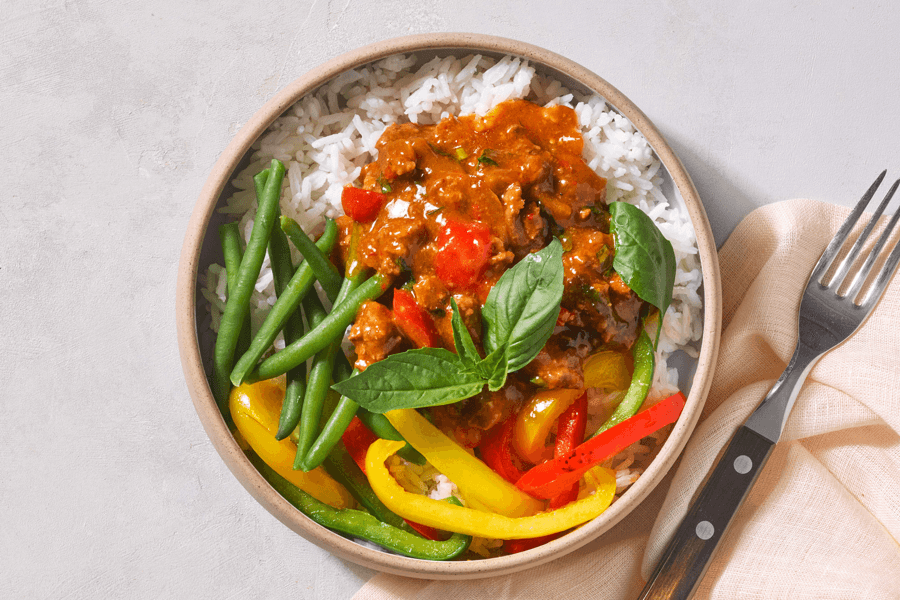
Try Frive's Meal of the month for May. Our delicious Thai Basil Beef.
The system-level fix: delete the cooking step, not the calendar
The popular advice to "just eat earlier" misses the actual professionals reading this. Your calendar isn't going to cooperate. The realistic fix isn't earlier; it's faster and cleaner on the nights it has to be late.
That means removing the cooking step entirely on the days when it's structurally impossible. Pre-prepared, nutritionist-designed, natural meals are the only option that simultaneously satisfies all three constraints: speed, nutritional quality and low cognitive load. Sunday batch-cooking is the DIY version; a quality natural delivery service is the outsourced version. Both work. Neither requires you to renegotiate your working day.
There's a recognisable pattern here. High performers across genuinely demanding professions; surgeons, pilots, founders; have stopped trying to make smart food decisions when they're tired. They make the decision once, in advance, and let the system carry the rest of the week.
How Frive handles the 8pm dinner
Frive is built around exactly this scenario: the night you finish work at 8pm and want to be in bed by 11pm.
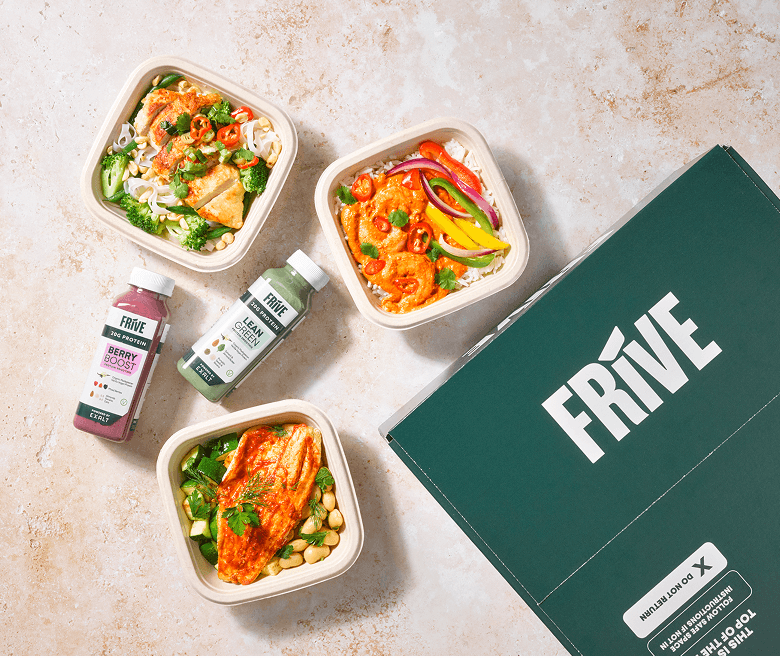
Three minutes from fridge to plate. No chopping, no stovetop, no washing up; and no executive-function load at the wrong end of the day.
30 to 40g natural protein per meal. British chicken, fish, lean beef, tofu, eggs. Real ingredients, not protein powder.
A complete plate, every time. Protein, complex carbs, vegetables and healthy fat in every box. Every macro covered without you having to think about it.
No UPFs, no seed oils, no emulsifiers, no refined sugar. The exact things that make 9pm takeaways biologically expensive are designed out.
100+ rotating menu options. No Thursday-night meal-prep fatigue.
Designed and reviewed by registered nutritionists. The easy option is also the right option.
You walk into a quiet kitchen at 8:15pm, you eat well at 8:18pm, and you're winding down by 8:35pm. You protect your sleep by deleting the cooking step; not by trying to eat earlier.
Try Frive this week: browse the menu, see how Frive works, or explore the plans.
Related reading on the Frive blog
For the midweek version of this problem, read Why Wednesday Dinner is the Hardest Meal of the Week (And How to Fix It). For the systems-thinking case against Sunday meal prep, see Midweek Meal Planning Is Dead: Here's What Smart Professionals Do Instead. For the late-training crossover, read The Healthiest Dinner You Can Have After a Gym Session (That Takes 3 Minutes). And for the day-long energy story, our piece on Why Your Lunch Is Making You Tired is the closest companion.
Frequently asked questions
Is it bad to eat dinner after 8pm?
It depends on what and how. Eating after 8pm isn't categorically harmful for healthy adults, but a cooked-from-scratch, high-glycaemic or ultra-processed meal at that hour reliably blunts deep sleep, compresses REM and raises next-day insulin resistance. A 30 to 40g protein, low-glycaemic, natural meal eaten in under five minutes is much closer to neutral.
How late is too late to eat before bed for good sleep?
Aim for a buffer of two to three hours between finishing your meal and bedtime. Less than 60 minutes is associated with longer sleep onset, more fragmentation and reduced slow-wave sleep. If you finish work at 8pm and aim to sleep by 11pm, eating by 8:30pm fits the window; provided you skip the cooking.
Why does cooking late at night make it harder to sleep?
Cooking is an executive-function task. Recipe-following, timing pans and judging doneness all keep cortisol elevated and the sympathetic nervous system in "doing" mode at the point cortisol should be falling. Bright kitchen lighting suppresses melatonin, and the washing-up phase keeps you physically active. The combined effect is the familiar wired-but-knackered feeling at 11pm.
What should I eat for dinner when I'm too tired to cook?
Aim for 30 to 40g lean protein, a low-GI carb source (lentils, quinoa, sweet potato), at least two vegetable sources and a healthy fat (extra virgin olive oil, avocado). Examples: cold poached salmon with chickpeas and avocado; cold roast chicken with butter beans and rocket. The cooking step must have happened earlier in the week, either via weekend batch-cooking or via a pre-prepared natural meal service.
Does eating late cause weight gain, or is it the food choice?
Both, separately. A 2013 University of Murcia study (the ONTIME programme) found that late eaters lost significantly less weight than early eaters even when calories, macros and sleep duration were matched; the timing itself mattered. Layer in the food typically chosen at 9pm (ultra-processed, high-glycaemic) and the effect compounds.
Is a takeaway better than skipping dinner if I finish work late?
Usually no. Ultra-processed takeaways are engineered to override satiety signals, so you eat past fullness right before bed at exactly the point evening insulin resistance is peaking. A small natural meal beats either option; if those aren't available, a piece of fruit with a handful of nuts is a fair fallback.
What's the best protein source for a late dinner?
Natural protein outperforms a shake at this hour. Oily fish (salmon, mackerel) brings omega-3s and sleep-supporting micronutrients; chicken or turkey are clean lean protein; eggs deliver tryptophan and a complete amino-acid profile; tofu or tempeh are the plant-based equivalents. Aim for 30 to 40g, enough to support overnight muscle protein synthesis without overloading evening digestion. Avoid heavily processed meats and oversized red-meat portions, both of which extend digestive time.