TL;DR: There are five realistic ways to feed a team at work: a contract caterer with an on-site kitchen, an aggregator or delivery platform, a chilled individually portioned meal programme, an allowance or vouchers, or nothing at all. Which one fits depends on headcount, how much attendance varies, what food is nearby and how much admin you can absorb. Feeding people occasionally and feeding them regularly are different problems with different answers.
Almost every business orders food in at some point: a board lunch, an all-day workshop, a team working late on a deadline. For plenty of employers, it stops there. For others, it becomes part of how the week runs, whether that is lunch on the company one day a week or a proper meal every day for a team on site. What suits the occasional function is rarely what suits feeding the same forty people every Tuesday, so the first job is working out which of the two you are solving for.
This guide covers what each of the five options is good at, what it costs in money and admin, and how to choose between them. Worth knowing first: most UK employers still provide nothing at all, and free drinks and snacks remain the most commonly offered workplace perk at 50%.
For many readers, the real question is not which supplier to pick, but whether to do anything, and what providing food might do for their people and their business.
The five models, compared
Cost only compares meaningfully per head per attendance day. Compare per delivery, per order or per month, and you are comparing different things.
That last row surprises people, so it is worth stating plainly: food provided at the workplace can be entirely tax-free under a long-standing exemption, while cash and high-street vouchers are taxable pay. More on that under option four.
Option one: Should you bring in a contract caterer?
A contract caterer runs a kitchen or servery on your site, usually on a management fee plus the cost of food and labour, and usually on a multi-year agreement. With the headcount, the floor space and predictable attendance, nothing else comes close for atmosphere or range.
The honest constraints are space and scale. It needs a kitchen, storage, and enough people through the door each day to justify the fixed cost, which is why it remains a big-employer model: only 3 in 10 UK workers have access to a workplace restaurant, according to Compass Group’s Eating at Work research with Mintel. Set-up is the other barrier: Just Eat for Business puts a mid-size canteen fit-out at £400,000 or more, before a single meal is served, and that figure is published by a competitor to contract catering, so treat it as indicative rather than a quote.
The market itself is healthy and worth reading carefully. UK contract catering sales grew 10.5% year on year in the first quarter of 2026, while the number of outlets served grew 4.0%, according to the CGA by NIQ tracker with Bidfood and UKHospitality. Demand is real, but it is not translating into a rush of new on-site kitchens.
Choose this if: you have several hundred people on site most days, the space to feed them, and you want food to be part of the building rather than a delivery.
Option two: Are aggregators and delivery platforms the answer?
Platforms like Just Eat for Business and Deliveroo for Work let you order in from restaurants and caterers with no commitment, no minimums and enormous variety. For a monthly team lunch, a board meeting or a one-off celebration, this is the right answer. Nothing else gives you that much choice with that little setup.
Where it strains is recurring, daily feeding of a team whose numbers move:
- Someone has to run it. Every order needs someone to collect preferences, place it, chase the delivery and fix what went wrong. That job lands on an office manager or EA every time.
- Costs move week to week. Restaurant pricing, service fees and delivery charges make budgeting an estimate rather than a line item.
- Shared platters and allergens do not mix well. Once food is out of its packaging on a communal table, allergen information is only as good as the label someone remembered to keep.
- Ordering for other people is a thankless job. The vegan gets a side salad, an order goes missing, and whoever volunteered gets the blame.
Choose this if: your need is occasional, event-driven or unpredictable, and variety matters more than routine.
Option three: What about a chilled, individually portioned meal programme?
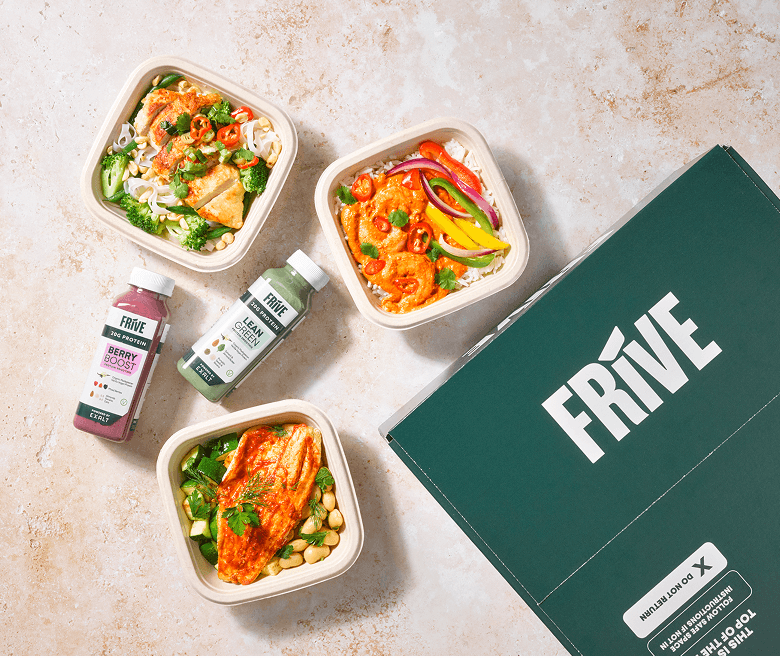
This is the newest of the five and the least understood, so it is worth being precise. It is not catering: nobody cooks on your premises. Employees choose their own meals in advance from a rotating menu, meals arrive chilled and individually labelled, and people heat them when they want to eat. A fridge and a microwave are the whole infrastructure.
What makes it different from the first two options is that it answers two problems structurally rather than through somebody’s effort:
- Variable headcount. Because people order individually in advance, you pay for the meals people actually asked for. There is no forecasting and no cooking for 80 when 50 show up.
- Dietary requirements and allergens. Every meal is portioned and labelled for one person, so the halal, vegan and gluten-free members of your team are served by the same system as everyone else, not by an exception to it.
This is the category Frive for Work sits in, and it is a useful example of how the model works in practice:
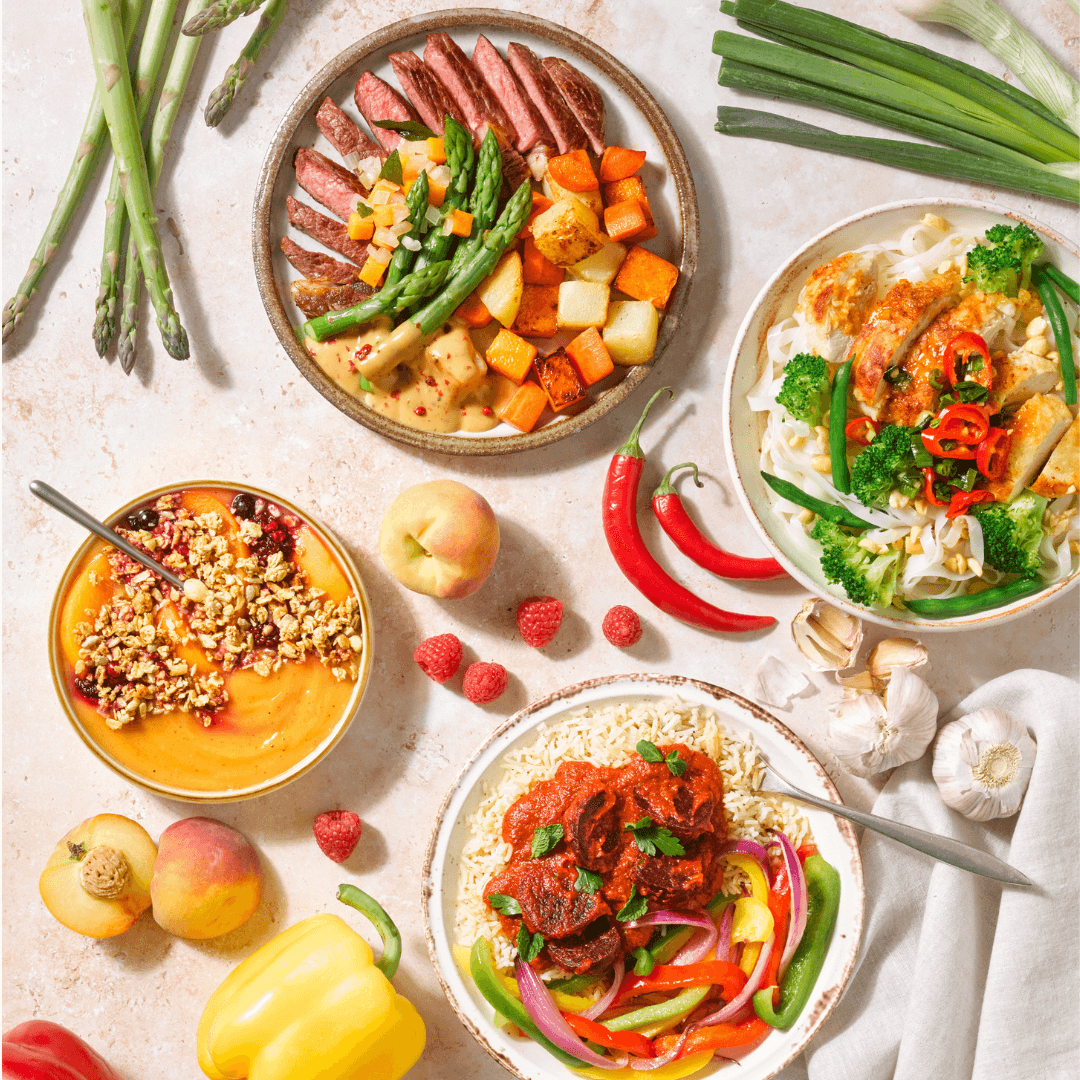
- The food. A rotating weekly menu of more than 40 dishes, chef-prepared from 100% natural ingredients with zero ultra-processed food. That is the part most workplace catering cannot claim, and it is the difference between feeding your team and simply putting food in front of them.
- Everyone chooses for themselves. This is the bit that changes the dynamic. Nobody is ordering on anyone else’s behalf, so the person who eats halal orders alongside the vegan, the coeliac and the colleague chasing a high-protein target, all from the same menu, in the same week, with no special arrangements, and nobody is left with the side salad.
- The logistics. Employees order ahead through their own account, meals arrive chilled on your delivery days and reheat in minutes. No kitchen, no catering team, no fit-out.
- The money. You set the weekly volume and decide whether to fund meals in full or part subsidise them, on one consolidated company invoice, from a minimum of 35 meals a week. Teams at Fulham FC, Harlequins, Lovehoney, Powerday and Tilda use it.
To find out more, click through to the Frive for Work page, where you can see how the ordering and delivery works and get a cost for your headcount.

Choose this if: you want a regular, dependable meal for a team of variable size, you have no kitchen, and dietary requirements matter to you.
Option four: Why not just give people an allowance or vouchers?
On the face of it, this is the most flexible option going: no supplier, no minimums, no admin beyond payroll, and total freedom for employees to eat what they like.
There is one significant catch, and it is expensive. Food you provide at the workplace can be completely tax-free, with no cap on its value. Money you give people to buy food is not. Cash allowances, credits to a card or account and high-street vouchers are all taxable earnings, with income tax and National Insurance to pay, and HMRC is explicit that arrangements handing employees money or value are not providing meals at all. Deliver £5 of lunch, and it costs you £5; deliver £5 of spendable value after tax, and it costs meaningfully more.
We have written a full companion guide to the tax treatment of employer-funded food. The short version: if the point is to feed people, providing food beats funding food.
Choose this if: your team is fully remote or so dispersed that provided food cannot reach them, and you accept the tax cost as the price of that flexibility.
Option five: What does doing nothing actually cost?
Doing nothing is the most popular option in the UK by a distance, and it deserves a fair hearing. It costs nothing, creates no administration, and leaves employees free to eat what they want. If your building sits on a high street with fifty options within five minutes, providing food can even feel like a nudge to stay at your desk rather than a perk.
The cost sits on the employee side of the ledger, and it has been climbing:
- A daily supermarket meal deal now runs to about £909 over a working year.
- Average UK food-to-go spend has reached £12.98 a visit, up 8.5% year on year.
- The UK lunch break now averages 33 minutes, with nearly half of workers eating alone, so for many people, the choice is already a hurried desk sandwich.
Choose this if: your people are well served by what is nearby, attendance is low or wildly unpredictable, and nobody has the capacity to run a food programme properly. A badly run one is worse than none.
What a food programme actually gives you
Before working out which model fits, be clear on what you are buying, because a staff meal does more than solve lunch.
- Money straight back into people’s pockets. On the numbers above, a funded lunch is worth close to £900 a year to someone who would otherwise buy it, and because food provided at work is tax-free, a pound you spend arrives as a pound of value. A pound added to a salary does not.
- A perk people genuinely use. The gym membership gets used by a fraction of the team, the wellbeing app is opened twice and forgotten, and the counselling line is a leaflet most people hope never to need. Lunch happens every working day, everyone is invited, and nobody has to sign up or find the motivation.
- A real contribution to health. You decide what is on the menu, which is a rare lever. Get it right, with proper food rather than ultra-processed convenience, and you improve what your team eats five times a week rather than talking about wellbeing in a newsletter.
- Something visible on the days people are in. For hybrid teams, a good lunch on anchor days is one of the few perks that is felt on precisely the days you want people together.
None of this makes providing food the right answer for every business. It does mean the comparison is about more than cost per head.

How do you choose? Five questions that decide it
Work through these in order. In our experience, the answer usually falls out by question three.
How many people, and how often are they in?
Several hundred on-site daily points to a contract caterer. Twenty to two hundred with variable attendance points to individually portioned meals. Fewer than a dozen points to an aggregator, or nothing.
How much does attendance vary day to day?
If Tuesday is 90 people and Friday is 25, anything that cooks or orders to a forecast will waste food or run out. Pre-ordering per person is the only model that tracks reality.
What is within a five-minute walk?
Fifty options nearby change the value of provided food completely. On a business park or an industrial estate, the same perk is transformative.
Do you have a kitchen and fridge space?
No kitchen rules out contract catering; no fridge space constrains a chilled meal programme. Measure before you commit.
Who is actually going to run it?
Name them. If it is an office manager already doing three jobs, choose the model with the lowest recurring admin, not the best menu.
When provided food is the wrong answer
Some readers should close this article and spend the money elsewhere. Provided food is the wrong call if your team is genuinely remote-first, because nothing on this list reaches people at home tax free; if attendance is so low that most meals go unclaimed; if your people value getting out of the building at lunchtime, which is a reasonable preference; or if it is standing in for a pay rise your team is expecting, because it will be received exactly that way.
Loading the menu…
So which one is right for you?
For occasional feeding, events, board lunches and the odd team celebration, aggregator platforms win comfortably, and nothing else comes close on variety. If you have several hundred people on site every day and the space to feed them, a contract caterer is still the gold standard. If your team is somewhere in between, wants feeding regularly rather than occasionally, has no kitchen and does not turn up in the same numbers every day, individually portioned meals delivered to the workplace are the model built for exactly that shape.
That last one is where Frive for Work comes in. Employees choose their own meals from a menu of 40 plus dishes made with 100% natural ingredients, meals arrive chilled and ready in minutes, and you set the volume and decide how much of the cost to cover, from 35 meals a week upwards, with no kitchen and no long contract. It is the difference between someone spending their Tuesday morning chasing a delivery and a team that simply gets fed.
Ready to see what it would look like for your team? Take a look at Frive for Work, or browse this week’s menu to see exactly what your people would be eating.
This article is general guidance, not tax or legal advice. Confirm the tax treatment of any arrangement with your own accountant. Last reviewed 3 August 2026.
FAQs
What is the alternative to office catering?
The main alternatives are aggregator and delivery platforms, chilled individually portioned meal programmes delivered to the workplace, and meal allowances or vouchers. Individually portioned meals are the closest substitute for daily catering because they need no kitchen and scale with attendance.
Do I need a kitchen to provide staff meals?
No. Contract catering needs an on-site kitchen, but delivered meal programmes need only fridge space and a microwave. Meals provided at the workplace can also be tax free whether or not you have a canteen, since the exemption covers any of your business premises.
What is the cheapest way to provide lunch for employees?
Per head, a delivered chilled meal programme usually costs less than daily aggregator ordering and far less than running a kitchen, because there is no fixed cost base. Cash allowances look cheap but carry income tax and National Insurance on top.
How much does it cost to feed an office per person?
Published figures are scarce. One London contract caterer publishes an expectation of roughly £10 to £15 per head per day for traditional catering. Most other providers do not publish per-head pricing, so ask each supplier for a written figure on a per attendance day basis.
Can employees choose their own meals?
It depends on the model. With a contract caterer people choose from what is served that day. With aggregator ordering, whoever places the order effectively chooses. With an individually portioned meal programme, each employee picks their own meals in advance from the menu.
What is the smallest team this works for?
Aggregator platforms work at any size, including a team of five. Delivered meal programmes typically carry a weekly minimum order, so they suit teams of roughly 15 upwards. Contract catering generally needs several hundred people on site to be viable.
Is providing lunch to staff a taxable benefit?
Usually not. Free or subsidised meals provided in a canteen or on your business premises are exempt from tax, with no cap, if they are on a reasonable scale and available to all staff. Cash allowances, card credit and high-street vouchers are taxable pay.