Chronic stress and short sleep genuinely drive weight gain, not through a lack of willpower but through biology. Sustained cortisol raises cravings for energy-dense food and favours fat around the abdomen, while as little as two short nights raise the hunger hormone ghrelin and lower the fullness hormone leptin. Food, stress and sleep form a self-reinforcing loop, and the fastest place to break it is a steady, earlier, natural evening meal.
You have cleaned up your diet. The takeaways are mostly gone, the portions are sensible, you are more or less in a deficit, and the scale still will not move, or worse, it is drifting the wrong way. Before you cut calories again, it is worth looking at the two levers most weight advice quietly ignores: how you sleep and how stressed you are.
This is not a willpower conversation. Chronic stress and short sleep change the biology of appetite and fat storage in ways that are measurable, well studied, and largely outside your conscious control. Here is what the evidence actually says, where the viral 'cortisol belly' content gets it wrong, and the practical order to fix things in.
Eating well but still gaining? Look outside the kitchen
In short: If sensible eating is not shifting the scale, the missing variables are usually stress and sleep. Weight is set by a triangle of food, stress and sleep, and the last two are chronically underweighted.
You can do everything right in the kitchen and still be fighting a body that is stressed, under-slept and, as a direct result, hungrier and more inclined to store fat. The plate is only one leg of the tripod.
None of this replaces energy balance; total intake still matters most. But stress and sleep quietly move the inputs to that equation, how hungry you are, what you crave, how well you recover from a heavy day, so treating them as irrelevant leaves a real lever untouched. The rest of this article takes each corner in turn, then puts them back together.
Picture the specific reader here: mid-career, in a demanding role, six hours of sleep on a work night, running on deadline adrenaline, and increasingly frustrated that a tidy diet is not being rewarded. The instinct is to eat even less. Often that is exactly the wrong move, because it adds another stressor to a system already tipped toward hunger and fat storage.
What does stress actually do to your weight?
In short: Chronic stress keeps cortisol elevated, and sustained cortisol both increases the appetite for energy-dense food and is linked to more fat stored around the middle.
Cortisol itself is not the villain; it is an essential hormone that wakes you up, mobilises energy and helps you handle a genuine threat. The problem is when the threat never switches off.
When stress becomes a permanent background hum (deadlines, caregiving, a phone that never stops), cortisol stays high for weeks rather than minutes. Researchers Tanja Adam and Elissa Epel describe how, in that state, stress reshapes the brain's reward system so that high-fat, high-sugar 'comfort' foods become genuinely more rewarding to eat. The reach for the biscuit tin at 9pm is a physiological pull, not a moral failure.
Timing matters here. A sudden, acute stress (a near-miss in traffic, a tense five minutes before a presentation) tends to suppress appetite; nobody feels hungry mid-crisis. It is the low-grade, chronic version that does the damage, because weeks of elevated cortisol keep nudging you toward calorie-dense food while the stress itself never resolves. Most modern stress is exactly this slow-burn kind, which is why the effect on weight builds quietly over months rather than announcing itself.
There is a body-composition signal too. In the Multi-Ethnic Study of Atherosclerosis, adults reporting high chronic stress carried on average around 9cm² more visceral fat, the fat packed around the internal organs, than those with low stress, after adjusting for age, sex and other factors. The effect is modest and it is a correlation, but it points in a consistent direction: stress and abdominal fat travel together.
The 'cortisol belly' trend: what is real and what is not
Social media has turned this into 'cortisol belly', complete with supplements, detoxes and face-and-tummy 'cortisol checks'. The honest read is that there is a kernel of truth wrapped in a lot of overstatement. As one UK analysis puts it, the trend often repackages ordinary diet culture as wellness science. The table below separates the two.
Why are tired days hungrier days?
In short: Short sleep rewires appetite within a night or two: the hunger hormone ghrelin rises and the fullness hormone leptin falls, so you wake hungrier and harder to satisfy exactly when willpower is lowest.
This is one of the most replicated findings in the field, and it has nothing to do with discipline.
In a tightly controlled study, restricting healthy young men to four hours in bed for just two nights was enough to raise ghrelin, lower leptin and increase self-reported hunger, with the sharpest cravings aimed at calorie-dense, sweet and starchy foods. Larger population work in the Wisconsin Sleep Cohort found the same hormonal pattern tracking with shorter habitual sleep and higher body weight.
Just two nights of four-hour sleep raised the hunger hormone ghrelin by about 28% and lowered the fullness hormone leptin by about 18%, and the men reported roughly 24% more hunger, with the strongest cravings for sweet and salty, calorie-dense foods.
It is not only hormones. Brain-imaging work led by Matthew Walker's group shows that after a poor night, the brain's reward regions respond more strongly to junk food while the frontal regions that apply the brakes go quieter. You are hit with a stronger pull toward the wrong food and a weaker ability to resist it at the same time.
Then there is the simple behavioural layer on top of the hormones. A tired brain makes more impulsive choices and stays up later, and the later you are awake, the more hours there are to snack. The 10pm scroll-and-graze is not a separate bad habit; it is the direct downstream of a short night, arriving exactly when the fridge is closest and judgement is thinnest.
This even shows up on the scale during dieting. When dieters were held in a calorie deficit but allowed only 5.5 hours in bed, they lost markedly less fat and more lean muscle than when the same people slept 8.5 hours. Same calories, worse result, purely from short sleep. If you count calories and still stall, our guide on why you might not be losing weight in a deficit covers the other usual suspects.
The loop that makes it worse
In short: Stress and sleep do not act alone; they form a self-reinforcing loop with food, where each turn makes the next more likely. That is why 'just eat less' rarely fixes it.
Here is the loop most late-finishing professionals are living in:
- A demanding day keeps cortisol elevated and squeezes the evening into a narrow window.
- Dinner drifts late, and depleted, end-of-day decision-making defaults to ultra-processed convenience food, the exact category stress makes more tempting.
- A late, heavy or processed meal, and the cognitive load of cooking at 9pm, disrupt sleep quality.
- You wake short on the sleep that regulates appetite, so ghrelin is up and leptin is down.
- The next day starts hungrier, more stressed and lower on willpower, so it fuels the afternoon energy dip and the pattern repeats.
The important point is that this is a systems problem, not a character flaw. The modern food environment is engineered to exploit precisely this tired, stressed state. You do not break a loop by trying harder at every point; you break it at its most controllable link.
How do you break the loop?
In short: Break it in evidence order, biggest levers first: protect a consistent sleep window, get morning light and movement, steady your food pattern, then move dinner earlier. None of it is a seven-day transformation.
The list below is roughly ordered by how much each change moves the needle, with food placed where it genuinely belongs rather than at the top.
- Protect a consistent sleep window. Regular sleep and wake times matter more than chasing a perfect eight hours once. If you sleep enough but still wake unrefreshed, our guide on waking up tired after eight hours digs into quality.
- Get morning light and some movement. Daylight early anchors your body clock and cortisol rhythm; a short walk does more for stress physiology than it looks like it should.
- Steady your food pattern with protein and fibre. Regular, predictable meals with enough protein and fibre flatten blood-sugar swings, blunt cravings and remove one daily decision. This is the corner you can act on tonight.
- Move dinner earlier where life allows. An earlier, lighter evening meal supports sleep. The barrier is rarely knowledge; it is the 9pm finish, which is a logistics problem, not a willpower one.
- Contain late alcohol and afternoon caffeine. Both fragment sleep quietly, and a nightcap in particular suppresses the deep sleep that regulates next-day appetite.
Be realistic about pace. None of these levers delivers a dramatic weekly drop, and anyone promising one is selling something. What they do is remove the headwind, so that a sensible diet finally translates into results instead of stalling. Expect the shift in cravings and energy within a couple of weeks, and the change on the scale to follow more gradually as the loop loses momentum.
Loading the menu…
Fixing the food corner without adding effort
In short: Food is the one corner of the triangle you can fix by removing effort rather than adding it, which makes it the practical place to start tonight.
Here is the trap in the list above: almost every item asks for energy you no longer have. By Thursday, the reader doing everything right is running on empty, and 'cook a balanced, earlier dinner' is precisely the task that collapses first.
It helps that food is also the corner with the clearest daily payoff. A meal with adequate protein and fibre steadies blood sugar, which flattens the energy crashes and cravings that stress and short sleep amplify. It will not lower your cortisol on its own, but a stable, natural pattern removes one reliable daily stressor (deciding what to eat) and stops the depleted evening from defaulting to the exact foods the evidence warns against.
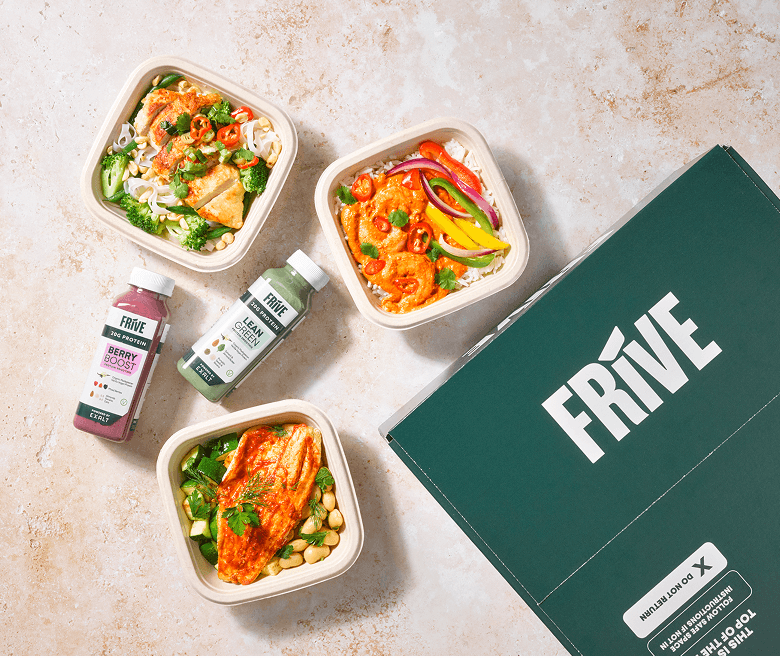
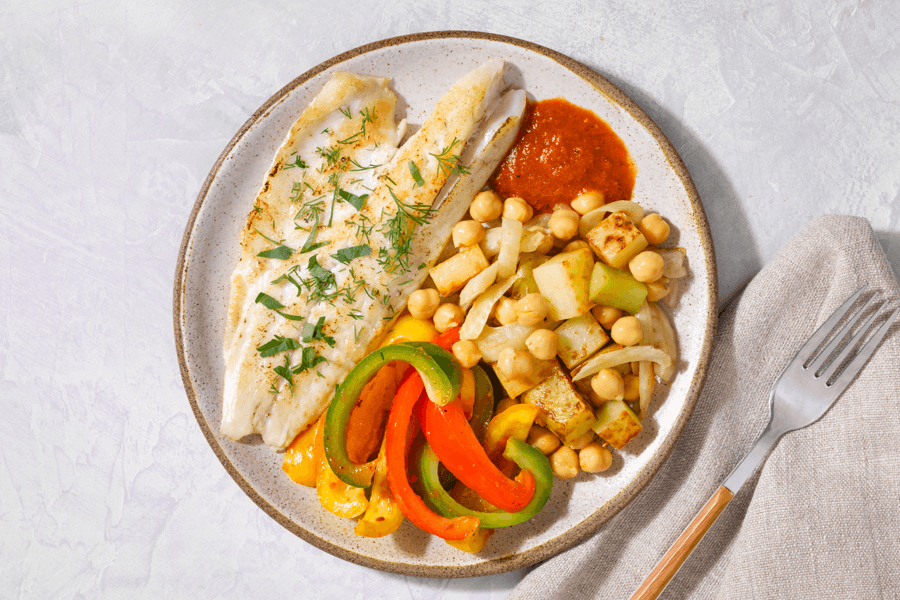
Frive cannot lower your workload or lengthen your night. What it can do is take the daily what-to-eat decision off the table and stop the depleted-evening slide into ultra-processed defaults, so the earlier, lighter dinner that supports sleep actually happens.
Natural, dietician-approved meals with the protein and fibre balance that steadies blood sugar and appetite through stressful days.
No ultra-processed ingredients, no seed oils, no artificial additives, replacing exactly the food category that stress and short sleep push you toward.
Ready in around three minutes, so dinner happens earlier and the evening gets a real wind-down instead of a 9pm cooking session.
Personalised to your goals and rotating across 100+ meals a month, so a dependable routine never becomes a monotonous one.
If the food corner is the one you want to fix first, that is a sound instinct: it is the most controllable and it makes the other corners easier. Have a look at the healthy ready meal plans or browse this week's menu to see how it fits your week.
FAQs
Can stress cause weight gain without overeating?
Mostly, weight gain still needs surplus energy, but stress makes that surplus far more likely. Sustained cortisol increases the reward value of calorie-dense food and can worsen sleep, and short sleep raises hunger hormones. Stress rarely adds weight in a vacuum; it stacks the odds toward eating more.
Does cortisol cause belly fat?
Partly. Chronic stress and higher cortisol are linked to more visceral fat around the organs, and cortisol does favour abdominal storage. But there is no unique 'cortisol belly' you can diagnose from a photo. Overall fat distribution is driven mainly by genetics, sex and total energy intake.
How much does sleep affect weight loss?
Substantially. In controlled dieting studies, people allowed only 5.5 hours in bed lost significantly less fat and more muscle than when they slept 8.5 hours, on identical calories. Short sleep also raises next-day hunger and cravings, making a deficit far harder to sustain. Sleep is a genuine weight-loss variable.
Do cortisol supplements work for weight loss?
No. There is no good evidence that over-the-counter 'cortisol-lowering' or 'cortisol-blocker' supplements reduce cortisol enough to change body fat. The trend is largely diet culture rebranded as wellness. Managing stress, sleep and your overall diet pattern is what actually helps, and costs nothing.
How many hours of sleep do I need to manage my weight?
Most adults need seven to nine hours, but consistency matters as much as the total. Regular sleep and wake times keep appetite hormones and your body clock stable. Chasing one long catch-up night does not undo a week of short ones, so aim for a steady window rather than an occasional marathon.
Why do I crave junk food when I am tired or stressed?
Because both states bias the brain toward reward. Short sleep strengthens the response to high-calorie food while weakening the frontal control that resists it, and stress raises the reward value of sweet, fatty foods directly. The craving is a predictable physiological output, not a lack of discipline.
What is the single most effective change to break the stress-sleep-weight loop?
Protecting a consistent sleep window, because sleep sits upstream of both hunger hormones and stress tolerance. If that feels out of reach on busy weeks, start with the most controllable corner instead: a steady, natural evening meal that happens earlier, which supports sleep and removes a daily decision.