| TL;DR |
|---|
| Under NOVA, almost all protein powders are ultra-processed, including plain unflavoured whey isolate. No trial shows ultra-processed protein sources build less muscle when total protein and calories are matched, and the meta-analysis of 49 trials and 1,863 participants behind the 1.62 g/kg protein figure was a meta-analysis of supplements. Where ultra-processed food does cost you is appetite and displacement. Judge a food on protein per calorie, fibre, added sugar and whether it replaces a meal or sits alongside one. |
Not in the way most people mean. There is no trial evidence that ultra-processed protein sources build less muscle once total protein and calories are matched. What they do is make it easier to eat more than you meant to, and easier to miss fibre.
Good whole ingredients are expensive, and they take time to turn into a meal. So it is no surprise that most of the food people lean on to hit a protein target is ultra-processed: whey powder, plant protein, bars, puddings, flavoured yogurts, mycoprotein, most breaded chicken.
And so does the research. The evidence that more protein builds more muscle was largely generated using exactly these products.
What is NOVA?
NOVA is a food classification system from Carlos Monteiro's team at the University of Sao Paulo. It is not an acronym; nova just means new in Portuguese. It sorts food by the extent and purpose of the industrial processing it has been through, not by how nutritious it is. Group 4 is what people mean by ultra-processed.
| The four NOVA groups | ||
|---|---|---|
| Group | What it covers | Examples |
| 1 | Unprocessed or minimally processed foods | Chicken breast, eggs, milk, plain yogurt, lentils, frozen veg |
| 2 | Processed culinary ingredients | Olive oil, butter, salt, sugar, honey |
| 3 | Processed foods, group 1 plus group 2 | Tinned tuna in brine, cheese, cottage cheese, tinned pulses |
| 4 | Ultra-processed formulations, typically built from extracted substances | Protein powder, protein bars, flavoured yogurts, mycoprotein, wholemeal bread, fizzy drinks |
Worth noting: Wholemeal bread, baked beans and plain whey isolate all sit in group 4. So does a bag of sweets. Keep that in mind for everything that follows.
Is protein powder ultra-processed?
Yes. Almost all protein powders are NOVA group 4, including a plain unflavoured whey isolate with nothing else in the tub. An isolate is a substance extracted from a food, which is the defining feature of group 4, however short the ingredients list is.
Now the interesting part. The most cited evidence that extra protein builds muscle is a meta-analysis of 49 randomised trials and 1,863 participants: fat-free mass up 0.30 kg, with no further benefit detectable beyond around 1.62 g of protein per kg of bodyweight a day. It is a meta-analysis of supplementation. The products in those trials were powders and shakes.
The evidence that protein builds muscle was built using ultra-processed foods.
So is your protein ultra-processed? A quick reference
| Is it ultra-processed? The gym cupboard, answered | ||
|---|---|---|
| Food | NOVA | The short answer |
| Whey isolate | 4 | Yes, even unflavoured. Extracted protein is the definition of group 4. |
| Whey concentrate | 4 | Yes, and flavoured versions carry more additives. |
| Pea or plant protein | 4 | Yes, for exactly the same reason as whey. |
| Protein bars | 4 | Yes, and further into group 4 than powder, because of sweeteners, binders and coatings. |
| Flavoured high-protein yogurt | 4 | Yes, because of the sweeteners and thickeners. |
| Plain strained Greek yogurt | 1 | No. Milk and live cultures, nothing else. |
| Mycoprotein | 4 | Yes, and it still delivers protein and fibre. |
| Breaded chicken | 4 | Yes. Plain grilled chicken breast is group 1. |
So here is the distinction that actually helps. A two-ingredient whey isolate and a 20-ingredient protein bar are both group 4. One is sweetened mainly with maltitol at roughly 30 g per 100 g, enough to put a laxative warning on the wrapper. They are not the same product. We have argued the whole-food protein versus shakes case separately.
In short: Yes, protein powder is ultra-processed, and so is the research showing protein builds muscle. The label is not tracking what you think it is tracking.
.png)
How reliable is the ultra-processed label?
Less reliable than it looks. Five things are worth knowing before you use it to shop:
Experts cannot agree on it. Asked to classify the same foods, trained evaluators agreed only at kappa 0.32 to 0.34. Just three of 120 foods were put in the same group by everyone. Most landed in two, three or four different groups.
It ignores nutrition. Between 26 and 35 per cent of ultra-processed foods earn top Nutri-Score ratings. That is how whey isolate and a bag of sweets share a category.
It carries cultural bias. A 2025 critical review notes tofu, a staple protein across Asian cuisines, lands in group 4.
Processed food supplies real nutrients. In US diets it provides 55 per cent of fibre, 48 per cent of calcium and 43 per cent of potassium, per the same review.
The UK position is cautious. SACN says it is unclear whether these foods are inherently unhealthy due to processing, and the NHS names ultra-processed foods that fit a healthy diet, including wholemeal bread, higher fibre cereals and baked beans.
None of which makes the category meaningless. The largest analysis to date, over 206,000 people and 16,800 cardiovascular events, found a modest association at a hazard ratio of 1.11. But it was concentrated in sugar-sweetened drinks and processed meats, while bread, cereals, yogurt and savoury snacks were inversely associated.
In short: NOVA measures processing, not nutrition, and it does so inconsistently. It is a population-level research tool being used as a personal shopping rule.
Does the source of your protein change how much muscle you build?
On the current evidence, no, once total protein and calories are matched. There is a caveat, and it is smaller than either side of this argument would like.
The eggs study everyone half-remembers
The famous bit. In 10 resistance-trained men, whole eggs beat egg whites for muscle protein synthesis after training at matched protein. The researchers put the gap at around 40 per cent. That number travelled a long way.
The bit that did not travel. Over 12 weeks in 30 resistance-trained young men, whole eggs and egg whites produced no difference in muscle mass. Whole eggs did produce greater strength gains, so it is not closed, and a 2021 review calls the evidence very limited.
Why it matters beyond eggs. In 23 men across 16 weeks of training, correlations between acute protein synthesis and actual muscle growth ran from r=0.02 to r=0.16. Effectively zero.
That last finding inoculates you against every headline claiming a food boosts muscle protein synthesis. A 40 per cent acute advantage did not become 40 per cent more muscle.
Animal protein versus plant protein
A systematic review of 18 randomised trials found no significant effect of protein source on lean mass, at a weighted mean difference of 0.22 kg (-0.02 to 0.46), and none on strength.
The caveat, stated plainly: percentage lean mass slightly favoured animal protein, the authors think it is marginally better for younger adults, and the results were not stable when trials were removed one at a time. If that effect is real, it is far too small to be what holds your training back.
What does hold training back is missing the total. Roughly 0.4 g per kg per meal across at least four meals gets most people to 1.6 g per kg, and our guide to how much protein you need per day has the working.
In short: No trial shows ultra-processed protein sources build less muscle at matched protein and calories. Total daily protein beats source, by a wide margin.
Where ultra-processed food genuinely works against you
In your appetite, not in your muscle. This is the part of the argument that survives scrutiny, and it matters more than anything above. Four trials tell the story.
| What the appetite trials actually found | ||
|---|---|---|
| Trial | What it tested | What it found |
| Hall 2019 20 adults, metabolic ward | Ultra-processed versus unprocessed diets, matched for calories offered, energy density, macros, sugar, sodium and fibre. Eaten freely. | 508 kcal a day more eaten on the ultra-processed diet. Plus 0.9 kg on that arm, minus 0.9 kg on the other, over two weeks each. |
| Brunstrom 2026 reanalysis of the same 20 | What people actually put on the plate under each diet. | On the unprocessed diet they ate 57 per cent more food by weight per meal, and still took in around 330 fewer calories a day. |
| Forde 2026 41 adults, crossover | Both diets ultra-processed, energy density matched. Only texture and eating rate changed. | 369 fewer calories a day on the slower-eating diet. Nothing about the processing label changed. |
| Gosby 2011 22 lean adults | Protein diluted from 15 to 10 per cent of energy. | Total energy intake rose by 12 per cent over four days. Low-protein food makes you eat more of everything else. |
Twenty people in a metabolic ward is small and artificial, so read Hall as a mechanism rather than a forecast of your week. But the Forde trial settles the argument: the cost is not the label, it is energy density, eating rate and how much protein the food carries.
Why a lifter should care is arithmetic. An unintended 300 to 500 calories a day decides whether a cut holds lean mass, and whether a gaining phase adds muscle or fat. Our guide to losing fat while gaining muscle covers the protocol, and why ultra-processed food drives hunger covers the mechanism.
In short: Processing costs you through appetite and intake, not through anything that happens in the muscle. Indirect, and still the thing that decides your result.
The second cost: what it displaces
A day built on shakes, bars and puddings can hit the protein number and miss almost everything else. Three things to hold in mind:
Fibre is the clearest loss. The NHS recommends 30 g a day and notes most UK adults get around 20 g. Most protein products contain almost none, so replacing a meal with a shake removes the vegetables, pulses and wholegrains that came with it.
But do not oversell it. Fibre's evidence is for long-term disease risk, not hypertrophy or recovery. No trial shows a whole-food diet beating a nutrient-matched processed one for training outcomes, so anyone promising better recovery is ahead of the data.
The practical version. Powder and bars are good supplements to meals and poor replacements for them. If the alternative is nothing, our protein snack ideas and high-protein lunches that hit 40 g at midday are the better swap.
Our guide to hitting 30 g of fibre a day covers the practical side, and the best foods for muscle recovery piece keeps the same honest framing.
In short: The question is not what the food is made of. It is what the food replaced. Alongside a meal, a shake is doing the job it was designed for, provided you have counted the calories. Instead of a meal, it costs you fibre and everything that travels with it.
What to look at instead of the NOVA group
Four things: protein per calorie, fibre per serving, added sugar and sugar alcohols, and whether the food replaces a meal or sits alongside one.
Protein per calorie, not protein per serving. A 20 g protein bar at 220 calories and a 20 g protein yogurt at 144 calories are not doing the same job.
Fibre per serving. Most protein products have very little. Anything replacing a meal needs some.
Added sugar and sugar alcohols. Polyols above 10 g per 100 g carry a laxative warning for a reason, and they are common in bars.
Replaces a meal, or sits alongside one. This changes the answer most often, and almost nobody applies it.
The gym-food audit
Every row is a food gym-goers actually buy, scored on those four things rather than on which NOVA box it falls into. Note how little the NOVA column predicts the verdict.
| The gym-food audit: what the NOVA label does not tell you | |||||
|---|---|---|---|---|---|
| Food | NOVA | Protein /100g | Protein /100 kcal | Fibre /100g | Verdict for muscle |
| Whey isolate, unflavoured | 4 | 84 g | 23 g | 2.0 g | Best protein per calorie here. Adds little else, and does not need to. |
| Whey concentrate, flavoured | 4 | 71 g | 19 g | 1.4 g | Nearly as efficient. More additives, same job. |
| Plant protein blend (pea) | 4 | 69 g | 19 g | 3.5 g | Comparable. Slightly more fibre. A fine choice. |
| Protein bar (60 g, typical) | 4 | 34 g | 9 g | 4.0 g | Half the protein efficiency of powder, often heavy in polyols. Snack, not staple. |
| High-protein pudding pot (200 g) | 4 | 10 g | 13 g | Not declared | Efficient protein, fibre not declared. Good snack, poor meal. |
| Flavoured high-protein yogurt (200 g) | 4 | 10 g | 14 g | Not declared | Same story. Genuinely useful for hitting a target. |
| Plain strained Greek yogurt, 0% | 1 | 10.3 g | 19 g | 0 g | Two ingredients, and matches whey concentrate for protein per calorie. |
| Greek-style plain yogurt | 1 to 3 | 5.7 g | 4 g | 0 g | Not the same product as strained Greek, and many add cream or thickeners. |
| Mycoprotein (Quorn pieces) | 4 | 14 g | 19 g | 8.3 g | An ultra-processed food delivering protein and serious fibre. |
| Chicken breast, grilled | 1 | 32 g | 22 g | 0 g | The benchmark whole food, and cheap protein per calorie at scale. |
| Breaded chicken breast, baked | 4 | 17.7 g | 8 g | 0.8 g | Same bird, roughly a third of the protein efficiency. |
| Cottage cheese, plain reduced fat | 3 | 10.6 g | 16 g | 0 g | Cheap, efficient, underrated. |
| Tuna, canned in brine | 3 | 24.9 g | 23 g | 0 g | Excellent, and it costs about a pound. |
| Baked beans in tomato sauce | 4 | 5.0 g | 6 g | 4.9 g | Ultra-processed, modest protein, real fibre. Adds to a meal. |
| Wholemeal bread | 4 | 9.4 g | 4 g | 7.0 g | Ultra-processed by NOVA, and named by the NHS as one that fits a healthy diet. |
Swipe the table sideways to see every column.
Whole-food values are from McCance and Widdowson's Composition of Foods and the British Nutrition Foundation; packaged products use typical UK label values, which vary by brand. Fibre is AOAC where declared.
Reading the table: three worked examples
| Three products, judged properly | ||
|---|---|---|
| Product | Protein /100 kcal | Verdict |
| Plain whey isolate | 23 g | Almost always taken alongside food. Efficient and useful, provided the calories are counted. |
| A supermarket protein bar | 9 g | Sweetened with polyols, usually eaten instead of a meal. Fine occasionally, poor daily, and the problem is the missing meal. |
| A flavoured protein yogurt | 14 g | No declared fibre. Useful on top of meals, poor as a substitute for one. |
Loading the menu…
How to get the healthy protein your body craves
Your protein powder is not the problem. The meals around it are. Three or four times a week most people who train choose between cooking something decent at 8pm and grabbing whatever hits the protein number fastest, and that choice sets your fibre, your calorie total and how much of your gain is muscle.
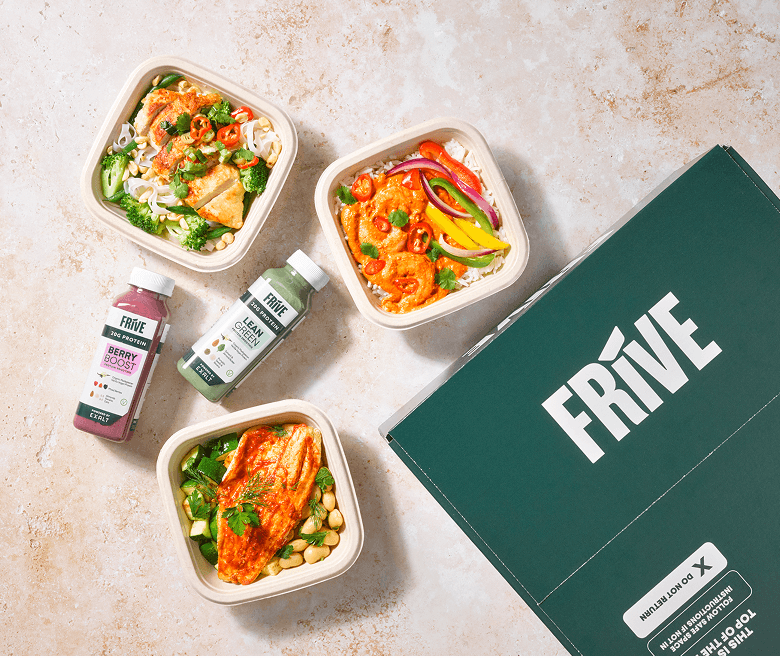
That is the gap Frive is built for: the meal, not the supplement.
High protein: options at 40 g and above, macro-balanced and portion-controlled
Chef-prepared: made from 100 per cent natural ingredients, never ultra-processed.
Weekly variety: a rotating menu of more than 40 dishes, ready in around four minutes.
It is not a better protein source than your shaker. It is the meal your shaker keeps replacing. If that is the corner you want to fix, start with the high-protein meal plan, and if you are wary of anything ready to heat, we have covered whether ready meals are actually bad for you separately.
FAQs
Is protein powder ultra-processed?
Yes. Under the NOVA system almost all protein powders are group 4, including plain unflavoured whey isolate, because a protein isolate is a substance extracted from a food. That classification describes how the product was made, not how nutritious it is, and no trial shows powder builds less muscle than food.
Is whey protein ultra-processed?
Yes. Both whey isolate and whey concentrate are NOVA group 4, since whey protein is extracted and refined from milk. A two-ingredient unflavoured isolate and a heavily flavoured concentrate share that classification despite being very different products, which is a good reason to read the label rather than the group.
Are protein bars ultra-processed?
Yes, and they sit further into group 4 than powder does because of the sweeteners, binders and coatings. A typical UK bar delivers around 9 g of protein per 100 calories against 23 g for whey isolate, and many are sweetened with polyols at levels that carry a laxative warning.
Is Greek yogurt ultra-processed?
Plain strained Greek yogurt is not: it is milk and live cultures, which is NOVA group 1. Flavoured high-protein yogurt pots usually are group 4, because of the sweeteners and thickeners. Greek-style yogurt is a different product again, with roughly half the protein of strained Greek yogurt.
Is mycoprotein ultra-processed?
Yes. Mycoprotein products such as Quorn pieces are NOVA group 4. They are also one of the clearest examples of why the group is a poor guide: Quorn pieces provide around 14 g of protein and at least 5 g of fibre per 100 g, which is more fibre than almost anything else in a high-protein diet.
Do ultra-processed foods stop you building muscle?
No. There is no trial evidence that ultra-processed protein sources build less muscle once total protein and calories are matched. Morton's 2018 meta-analysis of 49 trials and 1,863 participants, the source of the 1.62 g per kg figure, was itself a meta-analysis of supplements, which were ultra-processed products.
Can you build muscle on a diet with no ultra-processed food?
Yes, easily, provided you hit your daily protein target. Chicken breast, tuna, strained Greek yogurt, eggs, lentils and tofu will get most people to 1.6 g per kg without a supplement. The trade-off is convenience rather than results, which is why most people use some processed protein anyway.